
Why Some Questions Make Widows Feel Defensive or Insecure.
Widows are often asked questions about their grief that carry a hidden undercurrent with them. Here’s why some questions can feel painful—and what widows wish people understood.

Widows, can we talk about something for a minute?
Have you ever been asked a question about your grief and suddenly felt your body tighten?
Maybe your chest pulled inward.
Maybe your mind started racing.
And suddenly you felt defensive.
Or insecure.
Not because your grief is playing out wrong.
But because something about the question made you feel like you needed to protect yourself… or explain yourself.
Later you might find yourself wondering:
Why did that question bother me so much?
Why did I suddenly feel like I had to justify my grief?
If this has happened to you, you’re not imagining it.
And you’re not overly sensitive.
There is actually a reason this happens.
Let’s talk about it.
Sometimes the Question Isn’t Just a Question
Most people who ask widows questions have no intention of saying anything hurtful.
They care.
They’re curious.
They’re trying to understand something they have never walked through themselves.
But our culture quietly carries a lot of beliefs about how grief is supposed to work.
Many people have absorbed the idea that grief should gradually resolve over time. That eventually you should return to the person you were before the loss. That strong faith should make grief easier. That staying busy or focusing on the positive will help someone move on.
That healed grief should look like productivity, activity, and engagement with life again.
Some even believe grief is simply a mindset that can be managed or controlled if someone tries hard enough.
Most people don’t realize those ideas are shaping the questions they ask.
But boy, do widows feel them.
Sometimes before their mind even has words for why.
And suddenly the question doesn’t feel like curiosity anymore.
It can feel like evaluation.
Like someone is quietly measuring your grief.
Widowhood has a way of exposing how little language our culture actually has for loss.
Sometimes what widows feel underneath these questions is a quiet pressure that sounds something like:
Why can’t you just…
Why can’t you just move forward.
Why can’t you just stay positive.
Why can’t you just start living again.
But grief isn’t something we simply “just” our way through.
Why It Can Land So Deeply
When you lose your husband, grief doesn’t just touch your emotions. It reaches into absolutely everything.
Your body.
Your nervous system.
Your brain.
Your identity.
Your routines.
Your sense of safety.
Your place in the world.
Years of shared life created deep attachment.
Your brain wired in his voice, his presence, his rhythms.
Your nervous system learned to regulate alongside his.
Your identity formed around a life built together.
So when a question carries assumptions about how grief should behave, it can feel like something sacred is being questioned:
your love
your loyalty
your healing
your story
It’s no wonder your heart sometimes reacts quickly.
That reaction isn’t because of weakness, or confused thinking.
It’s the echo of attachment and love.
Sometimes what hurts about the question isn’t the actual words themselves.
It’s the measuring stick hidden underneath them.
Questions That Can Hit Widows Hard
Widows hear a lot of questions after loss.
Some are thoughtful and caring.
Others are simply people trying to understand something they’ve never experienced.
But sometimes a question carries an undercurrent — an assumption about how grief is supposed to work.
And when that happens, the question can land harder than the person asking may realize.
“How long has it been now?”
The undercurrent of the question:
Shouldn’t you be further along by now?
The truth widows know:
Love does not follow a calendar, or a timeline, or stages.
Grief may change shape over time, but it doesn’t disappear simply because months or years pass.
“Are you doing better?”
The undercurrent of the question:
Are you progressing the way I think healing should look for you?
The truth widows know:
The loss will never feel good or neutral.
And performing or pretending like it doesn’t bother us anymore can make us feel like we are betraying ourselves.
Some moments feel lighter.
Some moments feel heavy again.
Both can exist at the same time.
Doing better for us is being able to honestly communicate our grief without worrying about how it makes other people feel.
“Have you thought about dating?”
The undercurrent of the question:
Isn’t it time to replace what you lost?
Or to move on so you aren’t so sad?
The truth widows know:
Love and attachment do not simply reset.
There is no replacing the life and person we lost.
A new relationship doesn’t erase the pain or restore the person we were before loss.
Sometimes it feels like people believe the “old us” will return if we have a partner again.
But widowhood changes a life in ways that cannot simply be undone.
“Don’t you want to move on?”
The undercurrent of the question:
Are you stuck in your grief?
Do you like feeling this way?
Why can’t you just…
The truth widows know:
Grief isn’t something you choose to stay in.
It’s something you slowly learn how to live with.
And moving forward and carrying the person you love can happen at the same time.
“Do you still think about him every day?”
The undercurrent of the question:
Shouldn’t the attachment be fading by now? Shouldn’t you be further along?
The truth widows know:
We don’t ever want to forget them. In fact, at times we are afraid we will forget them.
“What would your husband want you to be doing right now?”
or
“How would your husband want you to be handling this now?”
The undercurrent of the question:
Are you honoring him by how you’re grieving?
This question can feel deeply insensitive to the reality we are living in.
Our entire grief experience exists because the person we built life with is gone.
Being asked to consider what they would want from us now can make the conversation shut down almost instantly.
It asks us to consult someone we can no longer turn toward in life.
The truth widows know:
The voice we most wish we could hear is the one we can no longer ask.
Widowhood forces us to learn something we never wanted to learn.
How to make decisions.
How to move through life.
How to think and choose on our own again.
Without the person we used to do life beside
Responses to Keep on Hand
Widows, sometimes the most helpful thing we can do when a question lands heavily is simply slow the conversation down.
Not with anger.
Not with withdrawal.
Just with clarity.
You might say something like:
Would you mind reframing that question a little? Sometimes my grief can color how I hear things, and I want to make sure I understand what you’re really asking.
Before I answer, can I ask what you’re hoping to understand?
Can you tell me a little more about what you’re asking?
That question can carry a lot underneath it. Can you tell me a little more about what you’re wondering?
Help me understand what made you ask that.
These responses don’t shut someone down.
They simply slow the moment down.
And sometimes that small pause is all it takes for the conversation to shift from assumptions to understanding.
One last thing I’d love for you to hear
Widows, many questions people ask about grief are not really questions.
They are beliefs about how grief should behave.
But grief does not follow cultural expectations.
Grief follows love.
And the depth of your grief is not evidence that you are doing something wrong.
It is the exact opposite… evidence that love existed.
Be Well,
Kimber

Understanding Grief After the Loss of a Husband

Many widows experience a complicated emotional and neurological response after the death of a spouse. Grief after losing a husband can affect the brain, nervous system, identity, and daily life in ways that many people do not realize. Researchers studying bereavement and attachment have found that grief can impact memory, concentration, emotional regulation, and the body’s stress response.

Widows often describe feeling misunderstood when others expect them to “move on,” stay positive, or return quickly to their former life. The truth is that grief after losing a spouse is not simply sadness. It is the result of deep attachment, shared life rhythms, and years of emotional co-regulation with a partner.

Because of this, questions about grief can sometimes carry unintended pressure. Many widows report feeling defensive or misunderstood when people ask if they are doing better, when they will move on, or whether they are honoring their spouse through how they grieve.

Learning about the impact of grief on the brain, body, and emotional life can help widows feel less alone and can help friends and family better understand what someone experiencing deep loss is actually going through.

This article explores why certain questions about grief can feel painful to widows and what many widows wish people understood about loss after the death of a spouse.Why crying helps the body release grief and why holding it in makes it harder
Crying during grief can feel frightening, but it often helps the nervous system release stress. This post explains why tears can bring relief in widowhood.

For many widows, crying feels dangerous.
Not emotionally — physically.
There’s a fear that once tears start, something will break open that can’t be contained. That the body will spiral. That the wave will grow instead of pass.
So many widows learn to do this instead:
swallow hard
tighten the jaw
distract
hold their breath
wait it out
It looks like strength.
But inside the body, something else is happening.
Crying is not a loss of control — it’s a nervous system response
Emotional crying is not the same as panic or emotional collapse.
It’s a biological response that involves multiple systems working together:
emotion processing
breath
facial muscles
tear glands
autonomic nervous system regulation
When grief rises, the sympathetic nervous system activates — heart rate increases, muscles tighten, breath shortens.
Crying often appears near the peak of that activation.
Not as a failure — but as a signal that the body has reached its limit and is beginning to release.
What research shows about crying and time
Studies on emotional crying consistently show:
most crying episodes last 5–20 minutes
intense crying rarely sustains beyond 30 minutes unless re-triggered
after crying, many people report:
calmer breathing
reduced tension
emotional softening
a sense of release
This doesn’t mean people feel “better.”
It means the stress response has begun to complete its cycle.
The grief remains.
The intensity shifts.
Why holding back tears often prolongs distress
Suppressing tears doesn’t stop the wave.
It interrupts the body’s attempt to regulate.
When tears are held back:
muscle tension stays high
breath remains shallow
stress hormones linger longer
emotional pressure builds internally
This is why widows often say:
“I didn’t cry — but I felt worse afterward.”
The wave had nowhere to go.
Crying isn’t what overwhelms the body.
Unreleased activation does.

The moment tears come is often the turning point
Many widows notice a pattern they’ve never been told to trust:
intensity builds
pressure peaks
tears come
breath loosens
fog begins to thin
Crying doesn’t end grief.
But it often marks the crest of the wave — the point where the nervous system begins to downshift.
The storm hasn’t passed.
But the worst of the wind has moved through.
When crying feels frightening or out of control
Some widows experience crying that feels panicky, breathless, or destabilizing.
This usually happens when:
grief is layered with trauma
the body is already exhausted
the nervous system has been in high alert for too long
tears are mixed with fear of the tears
In these moments, crying isn’t the problem.
The fear around the crying is.
Supporting the body — rather than stopping the tears — is what helps.
Gentle ways to support crying without forcing it
This is not about “letting it all out.”
It’s about staying with the body while it releases.
You might try:
placing a hand on your chest or stomach
allowing your breath to lengthen naturally after a sob
sitting or lying down so the body doesn’t have to hold itself up
letting your face soften instead of clenching
Nothing dramatic.
Nothing performative.
Just support.
What crying is actually saying
Crying is not saying:
“I can’t handle this.”
It’s saying:
This matters.
This hurts.
I need release.
Tears are not regression.
They are communication.
They are the body speaking when words are insufficient.
A sentence to hold when tears come
Crying often marks the peak of a grief wave, and allowing it can help the nervous system begin to settle rather than prolong distress.
You are not unraveling when you cry.
You are releasing what your body can no longer carry silently.
Coming next
In the next post, we’ll talk about grief fog, sudden calm, and emotional whiplash — and why going from “I’m okay” to “this is unbearable” and back again is not instability, but protection.
Because once widows understand that, they stop judging themselves for surviving.
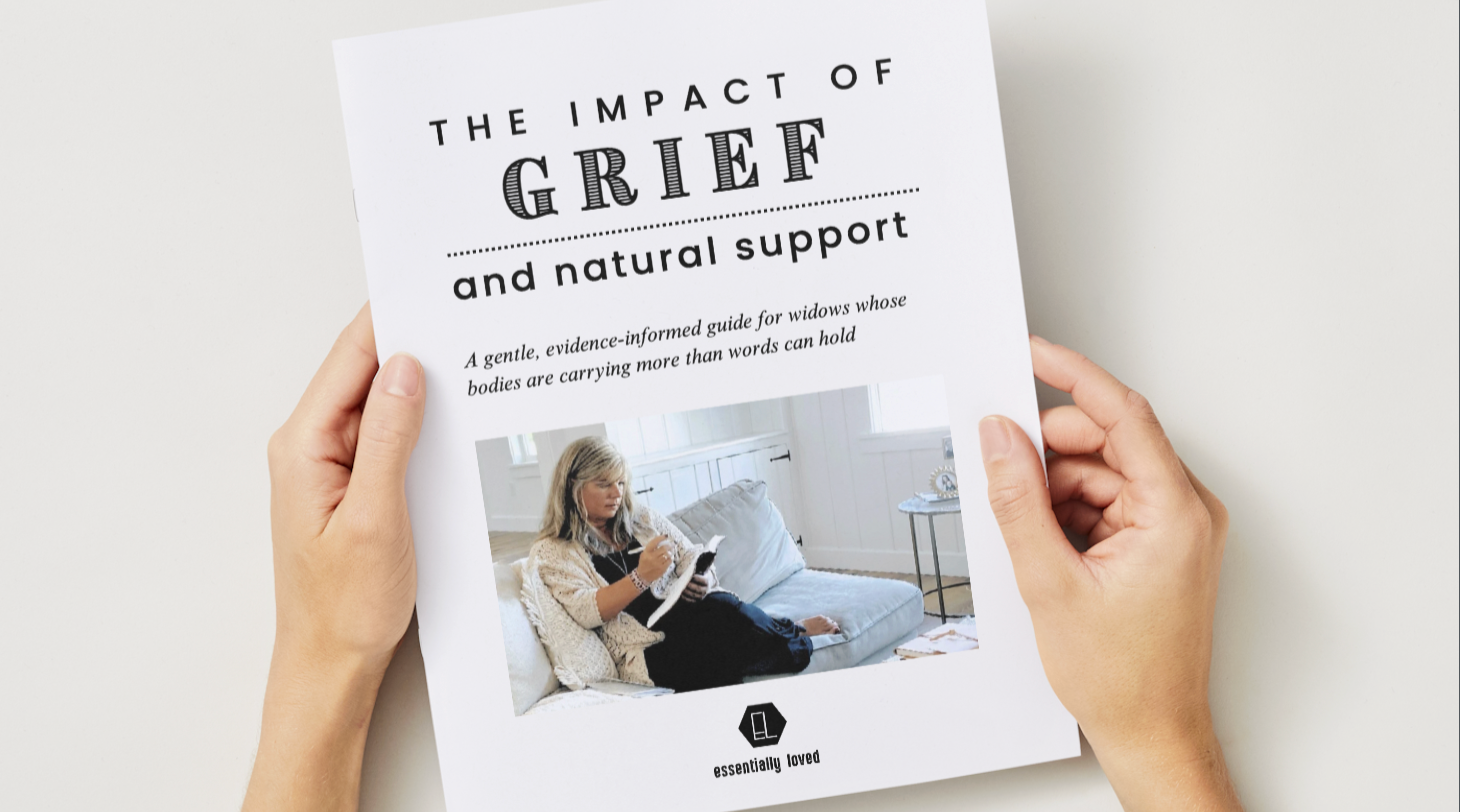
Want to learn more and find some practical helps? You can purchase The Impact of Grief Ebook
This article explains why crying during grief can help the nervous system release stress rather than make grief worse. It explores emotional crying, stress hormones, and parasympathetic regulation in widowhood, showing how tears often mark the peak of a grief wave and help the body settle. This science-informed grief education helps widows understand their tears, reduce fear around crying, and trust their body’s natural responses to loss.
How long grief waves last and why they feel endless when you're in them
Grief waves can feel endless, especially in widowhood. This post explains how long acute grief waves typically last, why time feels distorted during grief, and how the nervous system eventually settles.
One of the most fear-inducing parts of grief isn’t the pain itself.
It’s the fear that it won’t stop.
A wave hits and your body tightens. Your breath shortens. Your chest aches. Tears come fast or not at all. Thinking narrows until everything feels urgent and unbearable.
And somewhere inside, a quiet panic forms:
What if this never settles?
That fear makes grief harder than it needs to be.
So let’s talk honestly — and accurately — about what’s happening inside the body when a grief wave hits.
Acute grief waves have a biological time course
When grief surges, the body enters an acute stress response.
This involves:
activation of the sympathetic nervous system
release of stress hormones like adrenaline and cortisol
narrowing of attention and heightened emotional intensity
This state feels all-consuming — but it is not infinite.
Across stress-response and affective neuroscience research, there is a consistent finding:
The body cannot maintain peak physiological arousal indefinitely.
In most people:
acute emotional surges peak and begin to resolve within about 10–30 minutes
even very intense waves usually soften within 20–45 minutes
longer episodes often involve re-triggering, not a single uninterrupted wave
This doesn’t mean the sadness disappears.
It means the intensity begins to shift.
The wave moves.
Why grief feels endless while it’s happening
If grief waves are time-limited, why do they feel infinite?
Because during high emotional arousal, the brain’s sense of time changes.
When the stress response is active:
the prefrontal cortex (reasoning, time awareness) goes partially offline
the brain shifts into threat-based processing
the present moment expands and stretches
This is why:
five minutes can feel like an hour
you lose track of time while crying
you feel trapped inside the moment
This isn’t imagination or exaggeration.
It’s how the brain works under stress.
So when a widow says, “It felt like it would never end,” she’s telling the truth — about the experience, not the biology.
Crying often marks the crest of the wave
Many people worry that crying is what keeps a grief wave going.
In reality, emotional crying often happens near the peak of the stress response.
Studies on crying show that:
most crying episodes last 5–20 minutes
crying can activate parasympathetic (calming) pathways
after crying, many people report some degree of relief or settling
Crying doesn’t end grief.
But it often helps the body complete a stress cycle.
Tears are not the wave getting worse.
They are often the wave turning.
Why waves repeat throughout the day
Grief rarely comes as one long, steady experience.
Instead, it moves in cycles.
This is explained by what grief researchers call dual-process coping — the natural oscillation between:
loss-oriented states (pain, yearning, tears)
restorative states (neutral focus, functioning, brief calm)
Your brain cannot stay fully immersed in loss all day.
So it moves you in and out.
In early widowhood, this can happen:
multiple times an hour
dozens of times a day
This isn’t emotional instability.
It’s neurobiological protection.
The body is dosing the pain.
When waves last longer — what that usually means
Sometimes grief waves feel longer, heavier, or harder to come out of.
This usually isn’t because the grief itself is “stronger.”
Common reasons include:
exhaustion or sleep deprivation
hunger or dehydration
cumulative stress
repeated memory activation or rumination
lack of any settling input (rest, support, grounding)
In these cases, waves may:
stack back-to-back
feel like one long surge
take longer to soften
This is nervous system overload, not failure.
And it’s addressable.
Gentle practices that can help a wave move through
Nothing here is about stopping grief.
These practices simply help the body do what it already knows how to do: settle after a surge.
You don’t need to do all of these.
Even one is enough.
Name the wave
Quietly saying, “This is a wave,” can reduce panic and help the body stay with the experience.Support the breath without forcing it
Let your breath lengthen naturally. Even placing a hand on your chest can signal safety.Reduce stimulation
Lower lights. Sit or lie down. Fewer inputs help the nervous system exit high alert.Allow the tears
If they come, let them come. Resisting often prolongs distress.Orient gently when the fog lifts
Notice where you are. What you can see. What feels solid. This helps the brain re-anchor.
These are not fixes.
They are permissions.
A sentence to return to mid-wave
Most grief waves rise and begin to settle within minutes, even when the pain feels endless — because the nervous system is designed to crest and fall, not stay in peak distress.
You are not failing because it hurts this much.
You are surviving something that hurts this much.
Coming next
In the next post, we’ll look closely at why crying helps instead of harms, what’s happening in the nervous system during tears, and how to stop fearing the moment emotion breaks through.
Because understanding that changes everything for widows who’ve learned to hold it all in.
why widows need body-based support | grief impact + natural options
Widowhood doesn’t just break the heart — it overwhelms the nervous system. Grief affects sleep, stress, and the body itself. This post explains why widowhood feels so physically hard and how gentle, body-based support can help widows carry what love and loss demand.
Why widowhood feels so physically hard, and how somatic support can help you carry it
When your husband dies, it isn’t only your heart that breaks.
It’s your whole life that seems to crack open.
Your co-parent.
Your partner in decisions.
Your shared income.
Your witness.
Your future.
Your person who helped you breathe through hard days.
And somehow — impossibly — life keeps moving forward.
Decisions still need to be made.
Questions still get asked.
Systems don’t pause.
And your body is required to keep showing up, even when everything inside has been shattered.
If you’ve ever wondered why widowhood feels so physical — why your body reacts like you’re living in an emergency — there is a reason.
Not a “something is wrong” reason.
A nervous-system that is protecting you reason.
Because grief doesn’t live only in the heart.
It lives in the body that had to survive the loss.

Widowhood Is Grief Under Load
Widowhood isn’t just missing someone.
It’s missing him while still having to:
make every decision alone
keep the house running
carry the parenting weight
manage money stress
show up to work
answer questions you don’t even have words for
keep going when you don’t feel like you can
So the grief doesn’t “settle.”
It stacks.
And the body responds the way bodies respond when the load is too much for too long.
What Grief Can Feel Like in the Nervous System
During my husband’s cancer journey — including a failed bone marrow transplant — my body learned to brace itself
I lived depleted.
And after he died in 2019, that bracing didn’t dissipate.
The stress didn’t end.
It shifted into a new kind of constant that felt even more heavy laden.
I’ve known:
uncontrollable hyperventilating
panic that rises out of nowhere
night sweats
sleep that won’t come — or won’t stay
a nervous system that never fully powers down
If you’ve lived anything like this, I want you to hear this clearly:
This isn’t you being dramatic.
This isn’t you being “too sensitive.”
This isn’t a lack of faith.
This is your body carrying what love and loss demanded.
Bereavement research shows that grief can affect multiple systems at once — stress regulation, immune and inflammatory pathways, sleep cycles, cognition, and autonomic nervous system rhythms (fight/flight and rest/digest).
In other words: grief shows up in the body because you’re human, not because you’re broken.
Why Words Don’t Help — and “Just Relax” Feels Cruel
Some advice sounds harmless until you’re the one living it.
“Try to relax.”
“You just need to sleep.”
“Choose joy.”
But widowhood is a major life rupture.
And your nervous system isn’t malfunctioning — it’s doing exactly what it was designed to do when safety is disrupted and responsibility is relentless.
What widows need isn’t pressure to feel better, or to perform.
It’s support to feel grounded so we can keep moving on one step at a time.
how your sense of smell can help When Grief Is in the Body
This is where gentle sensory support — especially scent — becomes something more than “nice.”
A 2025 review published in Plants and available through PubMed Central describes aromatherapy and essential oils as complementary approaches that may support wellbeing related to stress, sleep, mood, and fatigue.
Here’s the part that matters for widows:
Inhaled aromatic compounds interact with the olfactory system, which is directly connected to brain regions involved in emotion, memory, and stress regulation — the same regions grief impacts most deeply.
This is why scent can feel immediate.
Why it bypasses logic.
Why it lands in the body before words do.
This isn’t about erasing grief.
It’s about giving your body a cue of steadiness inside the grief.
A few minutes of an encouraging or grounding scent paired with breath can become a sensory anchor — something your body recognizes as:
Right now, I can breathe.
Not because life feels normal again, or you have temporarily forgotten your pain.
But because you are being supported inside of your new reality.
Somatic Support: Helping the Body Carry What the Heart Is Carrying
Grief is not only something we think about. Or that happens to us.
It’s something we hold.
That’s why body-based practices are often kinder than mindset shifts.
They don’t demand positivity.
They don’t rush acceptance. They see what has happened and recognize it’s impact.
They offer the nervous system a different experience.
Try This When the Wave Hits
The Long Exhale Reset
Put both feet on the floor
One hand on your chest, one on your belly
Inhale through the nose for 4
Exhale slowly for 6–8
Repeat 6 times
If you want, pair it with a scent you associate with steadiness.
You’re not denying grief.
You’re telling your body it doesn’t have to brace quite so hard for the next minute.
Widow-Specific Aromatic Support Rhythms
(Simple. Doable. No pressure.)
These are not prescriptions.
They are rhythms many widows naturally resonate with when the body is wired, exhausted, or overwhelmed.
For Sleep When Your Body Won’t Land
Oils: Lavender + Cedarwood
Practice: Long exhales in bed
Breath prayer:
Inhale: “God, you are with me.”
Exhale: “You will never leave.”
For Mornings When Dread Hits First
Oils: Orange or Grapefruit
Practice: Open curtains, sip warm water, breathe before screens
Anchor phrase: “I am here. God is here.”
For Decision-Making When Panic Rises
Oils: Bergamot or Vetiver
Practice: Box breathing (4-4-4-4) before the call, errand, or appointment
For Grounding When You Feel Unreal or Unsteady
Oils: Frankincense or Vetiver
Practice: Press feet into the floor. Name 5 things you can see.
Ask gently: What is one next right thing?
Writing + breathing: How Widows Process Without Being Overwhelmed
This pairing matters more than most people realize.
Writing helps the brain integrate experience — giving grief somewhere to go instead of spinning endlessly inside the body.
When you add the benefits of essential oils, you give your nervous system a cue of safety + emotional support while you write.
That combination often makes it possible to stay present without getting swallowed.
The Gratefuls Practice
Use a comforting essential oil while you write.
12 small gratefuls (last 24 hours):
hot water in the shower
a text that didn’t demand anything
a moment your shoulders dropped
a song that felt like company
a meal you didn’t have to think too hard about
3 large gratefuls:
God’s presence
Survival through an unwanted season
A life that still holds meaning, even with pain
This doesn’t deny grief.
It widens the nervous system’s capacity to hold more than one truth at once.
Why I Personally Believe in This Support
I don’t share this as theory.
I share it because my body reached places words could not express.
Essential oils didn’t fix my grief.
They didn’t remove my loss.
But they gave my nervous system something steady to lean into and hold onto when everything else felt unsteady.
They helped me breathe when panic wanted to take over.
Sleep when my body wouldn’t land.
Stay present when the weight felt unbearable.
And over time, that really mattered and made a tremendous difference.
A Gentle Next Step (If You Feel Yourself Here)
If you’re reading this and thinking:
“I don’t need another thing — but I do need support,”
I understand.
I’ve put together some simple options for widows to find and explore using essential oils for nervous-system support.
You will find:
which oils I personally use and recommend for widows or those grieving
ways to use them simply (no overwhelm)
why these matter to me and how I use them
👉 [Explore essential oils for widowhood / grief support here]
A Closing Word for Widows
If your body still feels on edge, it doesn’t mean you’re failing.
It means you loved.
It means you lost.
It means you are still adjusting to the weight of carrying these two things at once.
And there are gentle, natural supports that can help you carry it — breath, body, scent, writing, prayer — small anchors that remind your nervous system:
You are not alone in this.
Research Referenced
Seiler et al., The Psychobiology of Bereavement — impacts on stress, immune, and autonomic pathways.
Caballero-Gallardo et al. (2025), Aromatherapy and Essential Oils as Complementary Wellbeing Support, Plants.

Widowhood grief affects more than emotions — it impacts the nervous system, sleep, stress regulation, cognition, and the body itself. Many widows experience physical symptoms of grief such as anxiety, panic, exhaustion, disrupted sleep, and nervous system overload following the loss of a spouse. Research in bereavement psychology and psychobiology shows that prolonged grief and caregiving stress can influence autonomic nervous system rhythms, immune and inflammatory pathways, and overall wellbeing. Gentle, body-based support — including somatic practices, breathwork, journaling, prayer, and sensory tools like essential oils — may help widows support nervous system regulation and carry grief with steadiness. This post offers grief-informed, natural support options for widows seeking holistic, faith-rooted ways to care for their bodies while navigating loss.
7 Goals That Actually Matter for Widows in 2026
Losing your husband doesn’t just break your heart—it reshapes your body, your faith, and your capacity for life. These seven grief-informed goals offer widows a different way forward in 2026—one rooted in safety, connection, and honest care beyond survival.

Losing your husband is disorienting.
There’s no easing into it. Grief doesn’t arrive gently—it takes you out. It knocks you flat on your face.
You try to get up, but the energy it takes just to stand leaves your legs shaky. The thought of walking forward—of moving into a life shaped by this kind of loss—feels beyond exhausting. Overwhelming in ways you didn’t know were possible.
Over time, you find a rhythm.
You learn how to get through the days. How to function. How to survive.
And for a while, survival feels like enough.
But somewhere along the way, a quieter question starts to surface—one you might not even say out loud:
Is survival really all there is now?
What if God has more for you than just surviving the death of your husband?
What if He honestly has more than just getting you through the day?
What about a life that still holds meaning?
What about purpose that doesn’t feel forced or fake?
What about moments that actually feel life-giving—the kind that settle your body, soften your thoughts, and remind you there is still goodness to be found, even here?
Because losing a spouse doesn’t just break your heart.
It changes how your brain works.
It changes how your body carries stress, fatigue, and emotion.
And it can quietly shift how you experience God, leaving Him feeling distant, muted, or harder to reach than He used to be.
Widowhood takes so much.
And yet… it also asks something new of us.
Not to move on.
Not to rush healing.
But to find a different rhythm—one that goes beyond survival and slowly opens space for life again.
That’s what these seven goals are about.
Not resolutions.
Not pressure.
Just what actually matters for widows stepping into 2026.

7 goals to help a widow move out of survival mode in 2026
1. create a heart space for your grief
Grief needs to be felt and processed to move.
So many widows carry the load internally—processing in their heads, over and over again. Ruminating. Over time, that kind of carrying becomes exhausting.
Making a heart space is about permission.
Permission to pause.
Permission to feel.
Permission to be honest.
This might look like creating a physical Grief Nook—a cozy chair, a journal, a wrap, a few meaningful objects. And time, time to be intentional. Time set aside where grief is allowed to exist without interruption.
Grief moves differently, more freely, when it knows it has a safe place to land and process.
And so do you. Having a physical space designed specifically to hold you well as you try new ways of processing the loss you carry with you — helps you to feel safe, seen, held and free to release.
2. Help your body feel safe
Grief doesn’t only live in the heart—it lives in the body.
After loss, the nervous system often stays on high alert. Sleep changes. Startle responses increase. Rest feels shallow or unreachable.
You can’t think your way out of that. Ruminating won’t resolve this.
Helping your body feel safe again might look like gentle grounding techniques, breath prayers, sensory awareness, or stillness. Small, repeated practices matter more than big efforts.
Science tells us that consistency helps the nervous system relearn safety. But even without knowing the science, most widows feel it when their body finds ways to exhale.
This isn’t about fixing the loss… because we can’t.
It’s about caring for yourself, and reminding yourself you are still safe and held in the midst of the ache.
3. Finding new ways to Sit with Jesus in your grief
Grief changes faith.
Prayer time shifts.
Scripture lands differently.
God can feel quieter—distant.
Many widows carry this unspoken thought:
”I don’t know how to be with God like I used to. I’m just not feeling it.”
God hasn’t changed but our ability to be present, connect, and feel safe in this world has..
This leads us to an invitation.
Sitting with Jesus in your grief and building authentic connection can look and feel very different after an extreme loss. Sometimes it looks like silence. Sometimes brutal honesty. Sometimes it’s a creative process. Often it is by engaging the imagination differently.
Jesus isn’t waiting for you to be “better.”
He’s already here. Right in the midst. He understands + loves you in the most tender way.
He sees you.
4. Practice gratitude without pretending
Gratitude after loss can feel very complicated.
It’s often mistaken for denial or forced positivity—and that’s not what this is about. At all.
This isn’t about slapping a grateful face on a broken heart or convincing yourself things are okay when they’re not.
And yet… there’s something important here.
Consistent gratitude practices are known to support the brain and nervous system, especially after trauma. They don’t erase pain—but they do help the mind notice moments of safety and goodness alongside grief, not instead of it.
That matters.
Because grief keeps the brain on high alert. And gratitude, practiced gently and honestly, can help soften anxiety and bring the nervous system out of constant bracing.
One simple rhythm many widows find supportive looks like this:
noticing small, everyday moments that don’t hurt
returning to a few big anchors that have carried you over time
Noticing doesn’t mean celebrating.
It just means allowing your brain to register something neutral or good without arguing with it.
Over time, this kind of practice helps different parts of the brain work together more smoothly. It creates small shifts—less looping, a little more breath, a little more space.
This isn’t about pretending life is okay.
It’s about helping your brain remember that goodness still exists in the middle of grief.
And sometimes, that’s enough for today.
GOAL 4 - Try listing 12 small gratefuls from the last 24 hours — little things you are thankful fo. And list 3 BIG gratefuls over the span of your life. Make a daily practice of this.
5. Move in ways that help grief move
Grief lives in the body.
Unprocessed emotion often shows up as tension, fatigue, pain, illness or restlessness. Thoughts loop. Emotions and experiences get stuck.
And surprisingly, movement doesn’t have to be an intense workout to be effective.
Walking. Stretching. Dancing. A gentle rhythm. Breathing while moving.
Somatic practices help emotions complete their cycle instead of lodging inside the body. Over time, movement can soften anxiety, bring clarity, and help your system release what it’s been holding.
In 2026, let movement be about listening, relaxing + releasing—not pushing.
6. Connection of the heart
Grief isolates in quiet ways.
Not always because people leave—but because it becomes harder to know how to share what’s real. You don’t want to overwhelm anyone. You don’t want to manage their reactions. Sometimes you don’t even know where to start.
Connection doesn’t have to mean a crowd.
It might be one trusted friend.
It might be a small grief group.
It might be intentional conversation where honesty is welcome and fixing or resolving is not the goal.
Grief moves differently when it’s witnessed. When it is held with care and kindness.
This is the heart behind The Widow’s Table Challenge—a six-week invitation into intentional, grief-informed conversation for widows and the friends who want to love them well.
No platitudes.
No pressure.
Just space to speak and be heard.
If you want more information on this sign up for the newsletter below. It will be coming out in January.
7. Letting your love go somewhere again
One of the quieter, less recognized, losses in widowhood is this:
your love suddenly has nowhere to go.
Your encouragement.
Your care.
Your tenderness.
Many widows unconsciously tuck this away, believing it’s safer not to offer too much of themselves. Or believing they don’t have the energy or will to offer it.
But we were created to love others. Love that has nowhere to go doesn’t disappear—it turns inward and grows heavy.
Letting your love go somewhere again doesn’t mean getting into a romantic relationship, or over-giving, or rescuing. It simply means allowing the gift of you, or something you have to offer, to be shared in a way that feels safe and life-giving.
Love is still a part of who you are. What you still carry and still have to offer.
And someone, somewhere, in this broken world needs what God has given you to offer.
Something thoughtful, something small, or big. A kind word, a thoughtful card, a meal…
2026 Goal - make a weekly pattern of giving some love and encouragement from your heart to another.
A word about time - Schedule it, write it down.
Grief has a way of distorting time.
Days blur.
Weeks slip by.
Months pass and you wonder where they went. And change can be hard.
This is where writing things down can be quietly powerful—not to track progress, but to help your brain light up. What fires together, wires together.
Journaling your grief experiences, recording your daily gratefuls, planning your weekly gives, or simply recording small rhythms can help anchor meaning in a season that often feels scattered.
This mattered.
I mattered.
This moment counted.
A gentle invitation
If this resonated, recognize that you’re not behind.
You noticed, you’re paying attention, and you are headed into new areas.
Through my newsletter, I share:
Grief Nook setup ideas
Somatic practices for nervous system care
Journal rhythms that don’t add pressure
Science-informed grief support
Details about The Widow’s Table Challenge
No fixing.
No rushing.
Just thoughtful + kind care for yourself in the wake of deep loss.
You are so welcome here. Just as you are.
And you’re welcome at the table.

Widows, do you need help moving beyond survival mode? Here are 7 steps you can make a priority in 2026.
Widowhood impacts the brain, body, faith, and relationships in profound ways that often go unseen. This grief-informed reflection offers widows practical and compassionate guidance for life after the loss of a husband, including nervous system support, somatic grief practices, spiritual connection with Jesus, honest relationships, and community care. Written for widows seeking meaning beyond survival, this article explores holistic grief support, faith after loss, and relational healing through intentional practices and safe connection. Additional resources, including grief journaling, Grief Nook setup, somatic tools, and the Widow’s Table Challenge, are available through ongoing support shared by the author.
Essential Oils & Practices for Grief Support for Widows | Supporting the body, brain, breath, and heart.
Grief after loss lives in the nervous system, the body, and the breath. This post shares essential oils and embodied practices for widows—supporting sleep, pain, digestion, emotional regulation, journaling, and gratitude as you carry grief forward.

Grief isn’t just emotional…
For widows, it lives in the nervous system, the gut, the immune response, the muscles, memory, and the breath.
Sleep is disrupted.
Pain increases.
Appetite changes.
The body stays on alert.
The mind feels foggy or overwhelmed.
This is not happening because you are weak.
It is grief doing what grief does.
Because grief lives in the body, it helps to have practices that support the body—with honesty. care, patience, and love.
Essential oils work by engaging these systems through scent, skin, and internal pathways, helping the body settle enough to process what the heart is carrying. Paired with embodied practices—breath prayer, writing, stillness, gratitude—they become loving companions in widowhood.
Not to avoid or repress grief.
But to help you stay present while you carry it.
How Oils + Practices Support Grief

Scent communicates directly with the limbic system—the part of the brain connected to emotion, memory, and safety. Writing engages both sides of the brain, allowing emotion and meaning to work together. Breath anchors the nervous system in the present moment.
Together, these practices:
support nervous system regulation
soften chronic stress responses
help integrate memory and emotion
create space for prayerful presence
They don’t erase sorrow.
They hold space for it.
1. Sleep
Settling the nervous system into rest
What it supports
Parasympathetic (rest-and-restore) activation
Reduced nighttime stimulation + alertness
Deeper, more consistent sleep rhythms
Why it works
Certain plant compounds influence GABA activity, limbic calm, and cortisol rhythms—all essential for sleep.
Use
Aromatic
Lavender • Roman Chamomile • Cedarwood (diffuse before bed)
Topical
Lavender + carrier oil on feet, chest, or back of neck
Internal
Lavender in warm tea or honey before sleep
Practice
Breath prayer in bed:
Inhale: “I am safe.”
Exhale: “I can rest.”
2. Waking Up — Uplifting & Hopeful
Gently re-engaging
What it supports
Dopamine and serotonin signaling
Mental clarity and motivation
Emotional release without overstimulation
Why it works
Citrus and herbal oils stimulate alertness centers and mood pathways while supporting oxygen flow to the brain.
Use
Aromatic
Orange • Grapefruit • Rosemary
Topical
Orange + rosemary on wrists or back of neck
Internal
Lemon or orange in warm water on waking
Practice
Open curtains
Speak one hopeful truth aloud while inhaling
3. Calming While Taking Action
Steady focus without panic
What it supports
Balanced nervous system tone
Reduced cortisol during decision-making
Calm energy for tasks that must be done
Why it works
These oils help regulate the stress response while maintaining mental clarity.
Use
Aromatic
Bergamot • Lavender • Vetiver
Topical
Roller on wrists before meetings, errands, or calls
Internal
Bergamot in tea before stressful tasks
Practice
Box breathing: inhale 4 / hold 4 / exhale 4 / hold 4
4. Grounding When You Feel Unstable
Re-anchoring when emotions feel shaky
What it supports
Sensory orientation
Vagal tone
Emotional presence and embodiment
Why it works
Resinous and earthy oils connect sensory input to emotional regulation and physical awareness.
Use
Aromatic
Frankincense • Vetiver • Patchouli
Topical
Diluted oil on feet or along spine
Internal
Frankincense in capsule or drop under tongue
Practice
Feet flat on the floor
Name what you feel in your body while breathing
5. Anti-Inflammatory Support
Easing the physical toll of prolonged stress
What it supports
Immune balance
Reduced inflammatory signaling
Tissue repair and recovery
Why it works
Many plant compounds influence inflammatory pathways and oxidative stress.
Use
Topical
Helichrysum • Ginger • Frankincense in carrier oil
Internal
Turmeric or frankincense blends with meals
Practice
Gentle warmth (compress or blanket)
Stillness afterward.
6. Pain Relief
Releasing tension and guarding
What it supports
Circulation
Muscle relaxation
Pain perception modulation
Why it works
Cooling and calming oils influence nerve signaling and muscle response.
Use
Topical
Peppermint • Lavender • Eucalyptus (massage slowly)
Internal
Ginger or turmeric
Practice
Long exhale breathing during massage
7. Digestion & Appetite
Restoring the gut–brain conversation
What it supports
Digestive signaling
Appetite awareness
Reduced nausea and tightness
Why it works
The gut and nervous system are deeply connected; these oils support vagal tone and digestive comfort.
Use
Aromatic
Peppermint • Ginger • Lemon
Topical
Clockwise abdominal massage (diluted)
Internal
Peppermint or ginger tea
Lemon in water before meals
Practice
Hand on belly
Slow breaths before eating
8. Forgiveness & Emotional Softening
Letting go without bypassing
What it supports
Emotional regulation
Heart-centered processing
Reduced emotional reactivity
Why it works
Floral oils engage emotional memory and parasympathetic response, supporting tenderness rather than defense.
Use
Aromatic
Rose • Bergamot • Ylang-ylang
Topical
Over the heart during reflection
Practice
Write what hurts
Then write what you’re releasing
9. Breath Prayers
Deepening connection through breath
What it supports
Vagus nerve activation
Emotional safety
Prayerful presence
Why it works
Breath and scent together slow heart rate and anchor attention.
Use
Aromatic
Frankincense or lavender
Topical
Chest or palms before prayer
Practice
Inhale 4 / Exhale 6–8
Pair with sacred phrases
10. Journaling & Gratitude
Opening the mind and heart
What it supports
Emotional integration
Memory processing
Creative expression
Why it works
Scent supports emotional safety while writing integrates brain hemispheres—bringing emotion and meaning back into conversation.
Use
Aromatic
Lavender • Rose • Bergamot
Topical
Roller on wrists while writing
Internal
Warm tea with citrus oil
Practice
Write freely
No fixing, no filtering
Gratefuls Practice
Write 12 small gratefuls from the last 24 hours
Write 3 large gratefuls across your lifetime
This practice helps the nervous system notice safety again and preserves what grief fog often tries to erase.
11. Emotional Regulation
When feelings come in waves
Supports
Hormonal balance
Nervous system steadiness
Blend
Clary Sage • Bergamot • Lavender
Practice
Hand on chest
Gentle rocking or swaying
12. Creative Clarity & Discernment
When grief fog dulls insight
Supports
Focus
Memory
Inspired thinking
Blend
Basil • Rosemary • Lemon
Practice
Use during creative journaling or prayerful listening

The Big Picture
Essential oils support grief by helping the body feel safe enough to:
rest
breathe
digest
soften
feel
and stay present
They don’t replace the work of grief.
They hold the body steady while the heart does it.
If you are a widow reading this, know this:
You are allowed to be supported.
Your body matters in your grief.
And gentle care is not a luxury—it is part of how you stay healthy and keep moving step by step.
natural ways to come alongside your grief and help it to become integrated within your body, mind and life as you move forward as a widow.
This article explores essential oils and embodied practices for grief support in widowhood, focusing on how grief affects the nervous system, body, brain, breath, digestion, sleep, pain, and emotional regulation. It offers holistic grief support for widows through essential oils used aromatically, topically, and internally, alongside practices such as breath prayer, journaling, gratitude, and nervous system regulation. This resource is designed for widows seeking gentle, faith-informed, body-based grief care that honors loss while supporting presence, integration, and daily life after death.

Widow, Grief & Brain Fog: How Deep Rest Activates Your Brain’s Cleaning Crew
When you’re grieving, sleep doesn’t come easy. Your brain’s “cleaning crew” - the glymphatic system - can’t do its work, leaving you foggy and exhausted. In this gentle guide, written for widows, discover how deep rest, hydration, natural care like essential oils, and small kindnesses can help your body and mind find rhythm again.

When Rest Feels impossible
There’s a kind of exhaustion that grief brings.
The kind that doesn’t seem to lift with a nap or the evenings of attempted sleep.
It sits behind your eyes, in your chest, in the middle of your thoughts - heavy, hazy, unrelenting.
If you’ve lost your person, you know this kind of tired. It’s not just sadness. It’s bone-deep survival.
Even when your body is still, your brain is working overtime - trying to make sense of loss, trying to keep you safe.
And when that happens, your brain’s healing rhythm—the glymphatic system—has a hard time doing its job.
⸻
The Brain’s Cleaning Crew: What the Glymphatic System Does
While you get good quality sleep, your brain runs a built-in detox system called the glymphatic system.
Think of it as your brain’s night-shift janitor.
During deep, slow-wave sleep, your brain floods with cerebrospinal fluid, which washes away toxins, stress chemicals, and waste proteins from the day.
This process clears what you’ve felt, processed, and held—all the invisible buildup of living, thinking, and surviving.
When this system flows well, you wake clearer, lighter, steadier.
But when sleep is disrupted—as it so often is in grief—the glymphatic “cleaning crew” can’t clock in. The result is what many widows describe as grief fog: forgetfulness, emotional swings, irritability, and a feeling that your brain just can’t keep up.
⸻
Why Grief Interrupts Deep Sleep
Grief activates your stress response system—the part of your brain wired to protect you from danger.
Your body releases cortisol, your heart rate rises, and your brain stays on alert, even when you want rest.
It’s common to fall asleep from sheer exhaustion and wake again in the dark hours with your mind racing.
The very rest you need most becomes the hardest to find.
Without those deep, slow-wave cycles, your glymphatic system can’t finish its nightly cleanup—and your brain starts carrying yesterday’s emotional and physical waste into today.
⸻
Signs Your Brain’s Cleaning System Is Overloaded
• Foggy or sluggish thinking
• Forgetting what you were about to do
• Emotional swings that come out of nowhere
• Physical heaviness or pressure behind your eyes
• Difficulty concentrating or praying
• Feeling “off” but not sure why
Of course, losing your spouse brings many of these issues.
Your brain is burdened with double-duty, empty spaces, new tasks, etc. — and this all brings a state of overwhelm and spinning thoughts. But also, understanding that there is a physical detox process your sleep can offer you each night to help with these things can bring a real sense of hope.
Let’s talk about some tangible ways to help find deeper sleep in the midst of your grief…
⸻
How to Support Deep Rest (and Help Your Brain HeaL
You can’t force sleep—but you can help to create the space where rest becomes possible again.
1. Create calm before bed.
Turn off screens an hour before sleep. Blue light signals your brain that it’s still daytime and suppresses melatonin. Choose quiet light, soft music, or a gentle prayer rhythm instead.
2. Hydrate often.
Your glymphatic system depends on fluid to flow. Keep a glass of water nearby throughout the day and sip before bed.
3. Try the “widow’s brain dump.”
Write down what’s looping in your mind—memories, to-dos, what-ifs, fears. You’re telling your brain: You don’t have to hold it all tonight.
4. Ease physical tension.
Apply a warm compress or massage your shoulders, neck, or jaw with a drop of lavender or copaiba blended in a carrier oil. These help calm the nervous system and release stored tension.
5. Avoid overstimulation.
Skip caffeine after 2 p.m. and heavy meals or alcohol within two hours of sleep. Both interrupt the deep-sleep cycles where brain cleansing happens.
6. Position for flow.
If comfortable, sleep on your side (especially the left)—studies show this helps cerebrospinal fluid drain more efficiently through the brain’s channels.
These practices can really help to ground your body and open it up to better sleep.
⸻
Natural Tools That Help the Body Remember Rest

Essential oils are a natural option that can help create the calm conditions your body and mind depend on: deep breathing, slower heart rate, and relaxed muscles.
To Release Tension
• Lavender – eases muscle tightness and lowers stress hormones.
• Copaiba – supports calm through the body’s endocannabinoid system.
• Frankincense – deepens breathing and grounds emotional overwhelm.
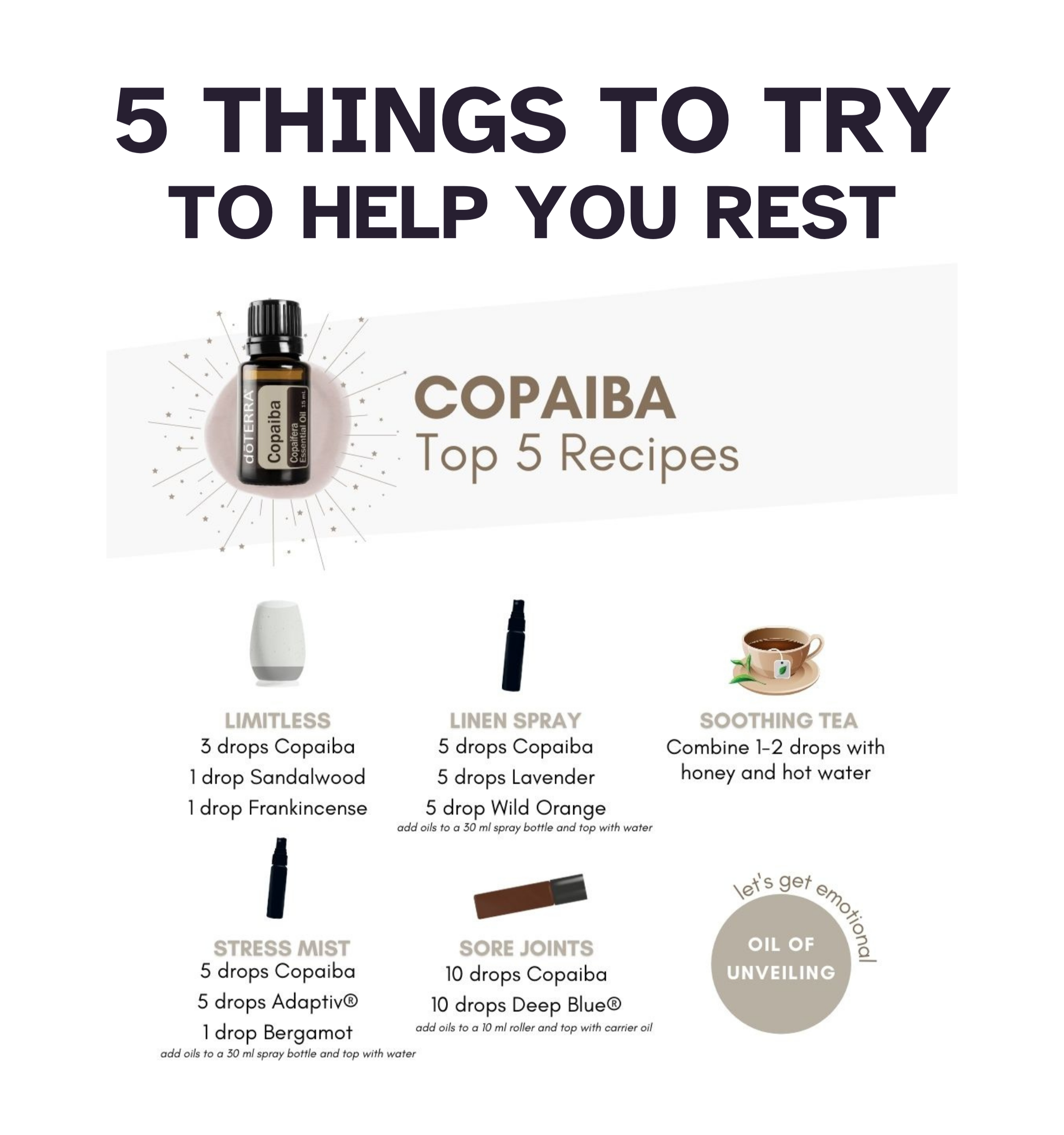
To Promote Deep Rest
Cedarwood – encourages melatonin release and stability.
Roman Chamomile – quiets restless thoughts.
Vetiver – deeply grounding; helps your body drop into restorative sleep.
How to use:
Diffuse 3–5 drops of lavender, cedarwood, or chamomile 30 minutes before bed, or add a few drops to an evening bath with Epsom salt.
For topical use, dilute 2 drops of any combination in a teaspoon of carrier oil and apply to neck, shoulders, or over the heart.
For my very favorite set and diffuser, you can grab it here: Essential oil kit + diffuser
If you would like to learn more about how essential oils work with emotions, click here
⸻
Things to Avoid (and Why They Matter)
Caffeine after 2 p.m. — Blocks adenosine, delaying sleep onset for up to 10 hours.
Blue-light screens — Suppress melatonin and keep your brain alert.
Alcohol close to bed — Fragments sleep and prevents deep, restorative cycles.
Late-night sugar or heavy meals — Keep your body metabolically active when it needs to be still.
⸻
Circle of Support TIPS: Helping a Widow FIND Rest
If you love someone who’s grieving, you can’t fix her sleepless nights—but you can help to make rest more possible.
Lighten her load. Do one small thing she doesn’t have energy for—laundry, groceries, or a meal.
Create a “rest basket.” Add herbal tea, a journal, magnesium lotion, a soft blanket, and a note: “Please care for your heart, mind and body by allowing yourself time to rest.”
Check in with curiosity, not pressure. Ask, “What’s been spinning in your thoughts?” or “What’s weighing heavier tonight?” Allowing space for your friend to release some of the mental tension she is experiencing.
Be still with her. Quiet companionship lowers stress hormones and helps her body feel safe enough to rest.
Pray peace. Short, simple prayers like “God, hold her mind steady while You keep watch” can calm both body and spirit.
⸻
A Gentle Reminder for the Weary
If your mind feels overhwelmed and your emotions keep spinning, it doesn’t mean you’re failing.
It means your brain has been working without rest, doing its best to carry what feels un-carryable.
Your body is wise.
Your brain knows how to restore you when given space and kindness.
Even here, my body is still working to protect me.
Even here, my brain remembers how to restore me.
Even here, I am being held.


Grief isn't an emotion, it's a lived experience.
Grief isn’t just an emotion - it’s a lived experience that imprints on the brain, body, and soul. In this post, grief coach and spiritual director Kimber explores why grief deserves dignity, how it rewires us, and what it means to carry love forward while learning to live with loss.
Grief isn’t just something you feel.
It’s something you live.
It doesn’t pass through or pass by over time. It settles in your chest, changes your pace, reshapes your thoughts, and carves its way into your everyday choices. Grief becomes part of how you breathe. How you think. How you carry love forward into a world that no longer looks like it once did.
It is not a moment or a stage.
It’s a recalibration - of what feels like, absolutely everything.
And the truth is, it matters.
Grief has VALUE
Grief matters because love matters.
Grief is not a sign that something went wrong. It’s a sign that something beautiful existed - something irreplaceable, something sacred.
It’s the shadow love casts when the person is gone, but the heartprint and wired in memories remain.
And that’s where things get confusing.
Because the relationship doesn’t stop.
The love doesn’t go away.
The memories don’t leave, even when the person does.
That’s the tension.
The friction of holding what’s still current in your soul… but not physcially true in your presence.
You still hear their voice.
You wait for their sound.
You remember the feeling of them right there beside you.
You brain has them wired into every moment of your future plans - and you have to wiggle through every single one of those as they come, working through them with your new reality.
It’s what I call a, holy ache: the presence of what was, still alive inside the absence of what is.
The Cost of Calling Grief “Just” an Emotion
Too often, the world will treat grief like a feeling.
Something that will pass. Something to be managed.
Something people expect you to "get over.", “get past”, “work through”, “come to terms with”.
But grief is not that simple.
When we minimize it to an emotion, we rush people through it.
We silence their voices with platitudes.
We dismiss their pain with timelines.
We shame them for the impact of loss that still remains or lingers.
But the truth is, grief doesn’t just touch the heart - it touches the brain. The body. The mind. The soul.
It disrupts thought patterns and memories. It changes your physical rhythms - your appetite, your sleep, your immune system. It alters how safe or unsafe the world feels. It reroutes every automatic thing you once knew.
This is not weakness. In fact, it takes tremendous strength.
It’s the cost of re-learning an entirely new life after loss.
This Is What Grief Looks Like
You have to reimagine every part of your day.
The person who once helped you decide things, calm your fears, make you laugh - they’re not here. And now it’s all up to you.
That’s not just painful.
That’s exhausting.
This is grief:
Trying to remember passwords.
Forgetting what day it is.
Staring into space.
Crying in the car.
Making a simple decision and feeling shattered by it.
Not because you’re broken.
But because your mind, body, and soul are doing the hard work of loving still, even in the absence. And that takes a strength that no one can see, or understand, unless they have sat in it.
And Yet, We Keep Going
Somehow, we show up.
Not always polished.
Not always okay.
But honest. Present. Carrying more than most people know.
We find ways to have grace for those who miss the mark on what this journey is about. Or what it should look like.
And slowly - over time - we realize something:
This grief has changed us. We have learned much in the process of it.
We have done extremely hard work carrying this love with us.
And we always will …
For the rest of our days we will carry the memories, the aches, and the gratitude.
You’re Not Meant to Carry This Alone
If you’re in this place - where your grief feels misunderstood - I want you to know something:
You're not alone.
And grief is not too much.
You’re not stuck.
You’re grieving.
And that’s holy.
It deserves time, tenderness, and space to be understood - not silenced.
As a grief coach and spiritual director, I walk with women navigating this ache - helping them find gentle ground beneath their feet again. Not rushing them. Not fixing them. But listening deeply and helping them carry this with honesty, presence, and dignity.
Grief and faith can walk together.
Tears and hope can live in the same body.
And even now - especially now - you are worth walking with.
A Gentle Invitation
If you're walking through deep loss and want someone beside you who understands both the neuroscience and the spiritual ache of grief, I’d be honored to walk with you.
You don’t have to figure this out alone.
Learn More About Grief Coaching + Spiritual Direction
We’ll move gently.
We’ll listen for what still matters.
And we’ll carry it forward - with kindness.
You can click below to set up a consult if you would like to see about walking together in your grief.

5 Surprising Symptoms from Held Grief
Dealing with grief isn't just about “feeling” sad—it can also show up in surprising physical ways that you might not be aware of. Often in grief we are just trying to get by, pushing on and/or sometimes repressing. These common responses may work short-term but long term can create some additional setbacks for us. Here are five unexpected physical symptoms that can come from grief unexpressed (or unmoved):
Aching All Over: Ever noticed your body feels achy or sore for no apparent reason? Grief can actually make your muscles tense up, causing back pain, headaches, or even joint stiffness.
Tummy Troubles: When you're grieving, it's not uncommon to experience digestive issues like stomachaches, bloating, or changes in your bathroom routine. Stress really does a number on your gut!
Catch Every Cold: Grief can weaken your immune system, leaving you more vulnerable to catching every bug that goes around. So, if you find yourself constantly under the weather, it might be more than just bad luck.
Heart Flutter: Have you ever felt your heart racing or fluttering unexpectedly? Emotional stress from grief can cause palpitations or irregular heartbeats that can feel pretty unsettling.
Sleep Struggles: Whether it's trouble falling asleep or feeling exhausted all the time, grief can seriously mess with your sleep patterns. It's like your mind and body are working overtime, making it hard to get the rest you need.

Recognizing these physical signs of grief is important because it shows how much our emotions can impact our bodies. Taking care of yourself during tough times isn't just about talking it out—it's also about being kind to your body, getting support from friends and family, and maybe even seeking help from a professional if you need it. Remember, it's okay to feel all these things, and taking care of yourself is always the right move.
If you feel stuck or are looking to find new ways to process your grief, you can sign up for a 30 min. consult with me here.

Recognizing Trauma Through Mind Scribble | Free Worksheet
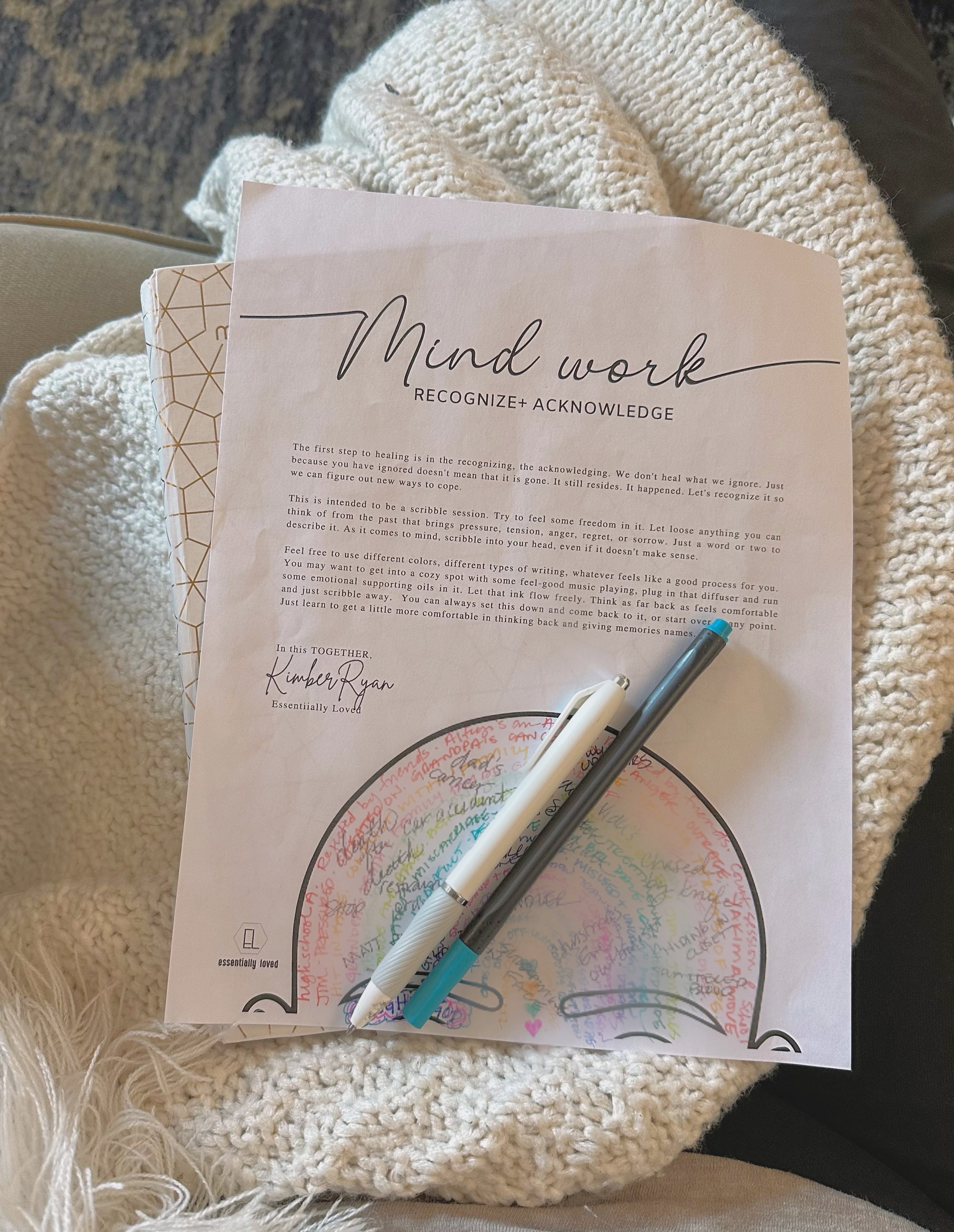
Trauma, it isn’t what happened, it is what happens within us as a result of harsh life events that impacted us. When we can’t process properly in the moment of the event it stores itself up in our mind and bodies. And it wreaks havoc just sitting there. Ignoring it just isn’t good enough, it’s eating at us, whether we can identify the damage or not. So, what do we do? We begin with recognition. We start by not being afraid to tap into what hasn’t been dealt with yet. I’ve created (what I think) is a fun process to loosen up and let go a little.

FREE worksheet. Save + Print. Recognizing Trauma thru Mind Scribble Worksheet | Essentially Loved
It all started today when I was watching a REALLY good sermon on Trauma. You heard me right, a sermon on Trauma. Craig Groeschel at Life Church did an excellent job of unpacking what trauma is, how important it is for the healing process to recognize it, and how this leads to a place where you can eventually use your pain for a purpose by helping others. This info wasn’t new to me but an idea in response to it was.
As I was listening to the end of the sermon an image of a worksheet popped into my head. I quickly created this worksheet and decided to give it a try. I have to say, I loved the process of it. I snuggled up on my cozy couch, with a cozy blanket, rolled some breathe on my chest to open my airways and mind, got my pens ready, and relaxed my way into the process.
As I was began I went in with a black pen to write down past events that popped into my head. I didn’t allow myself time to sit and process each event, I just remembered, jotted it down, and moved on to the next one. Then I decided to go back and create a more artistic expression with it. I grabbed colored pens and quickly scanned my life once again (starting a little younger), writing down what came to mind in a few words. For some of my entries I used letters, initials, or code words.
Feel free to save and print out the image on the left to complete your own. It’s free. I am SO for you finding freedom from the bound pain. I’m over here right now praying for you and your process. I know God cares so deeply about all you have been through. and he wants to help you heal. He really does.
Once you have worked through this and sat with it a little make sure and check back here. I’ll be sharing new posts to help with some next steps once you get this completed.
BIG SIGH, say a prayer asking God to hold you tight through the process, and let’s get to work.
You got this!

Do you trust me? The repeated question that changed my grief journey.
The other day I was sitting rather mindlessly allowing my thoughts to move with ease bouncing back and forth through memories and my current day situation. This relaxed state of mind practice seems quite natural to most but non-existent to many who are grieving. To allow the grieving mind to drift is to consider the thought of physically jumping into a boxing ring. You don’t know what thought will take that swing that leads to a knockout. The fact I was free to relax my thinking and coast back to review the lived-out chapters showed I was making progress.
As I sat there seeing the chapters of life without Dave flipping before me God revealed a piece of His beautiful offering that had helped provide me with shelter in the midst of the pelting grief storm. It was a question that was posed to me over, and over, and over, and over, and over, again and again. A question of weighted words that wouldn’t make space for a flippant answer. It was a question pointed like a magnifying scope looking straight to the core of my entire being.
“Do you trust me?” -Jesus
You see, my body and mind took many different forms in my grief: from laid out flat sleeping to a curled-up sobbing fetal position. From arms waving in the air praising, to my head resting on my Bible soaking. From scuffing my feet through the red soil of Africa serving, to lounging at my friend’s cabin receiving. From voraciously studying and creating in order to provide my way, to trying to relax just enough to find calm in my racing heart with solitude and rest.
I was scared in the face of the unknown and I was doing everything I knew I should to find my way and make my path straight. Until I couldn’t, and then I would run like crazy and try to escape the pain. Until I realized the pain follows you because it is part of you, it dwells within. There is no escaping it. So, back to creating. Back to learning. Back to doing. Back to… you name it.
BUT THROUGHOUT.
This is the part that matters most. This is the plumbline of truth that keeps our foundation level when we build upon it. That repeated question asked throughout the mayhem of my stability-building attempts: “Do YOU trust ME?” -Jesus?
The question would often catch me off-guard, stop me in my tracks, and take my heaving breath away from me. My vision would narrow in on Him, eyes locking, nerves settling, worries decreasing, fear subsiding, grounding found. “YES.” “I trust YOU, Jesus.”
“I question this world and the people in it, myself included. But I trust you yesterday, today, and forever.” Honestly. In the wake of the storms, my answer is still YES. More now than ever. and with that trust, the next step comes a little easier. Jesus is indeed trustworthy even in the unknown and in the broken.
I could write five chapters on this but for now, I want to keep it to this next point: When the unknown of your future gets loud or feels shakey, there is a way through it. This pattern of a repeated trust statement changes things. The key is that you have to believe it. You have to envision a very real Jesus holding your hand, scooping you up, leading the way, walking alongside, gazing into your eyes, and seeing the very core of your being. He knows you, He loves you, and every single thing about you matters to Him. He has a plan for you and it is a really good one.
Not despite the broken but because of it.
Do you trust Him?

Unfelt Grief | How to Honor Your Sadness + Process Through It

Pain, it’s natural for us to want to avoid it, right? Our built in avoidance techniques shift into gear before we even recognize them. This leads us to a place of trapped emotions. These emotions can wreak havoc in our mind and bodies.
I don’t know what events lead you here. But for me the alarms signals began blaring after I lost my husband. I had been through a lot of loss + hardship prior to. Unfortunately, I thought I was handling the past events fine. As I have been learning new ways to process my sadness and recognize triggers old stuff has emerged as well. My body was keeping the score.
So in this post I want to WELCOME YOU to a simple practice of honoring your sadness. Helping you to see that you don’t need to be afraid of it or press it down. I want you to have freedom from the fear of sadness leaking out or erupting by practicing ways to welcome it. With the practice of holding sadness sessions, by allowing it and moving it through, it will help release a lot of the pressure of the unexpected outbursts. Oh, triggers will still bring some tears but they may not have the same energy behind them and you will know what helps you to move through it. This really helps, truly.
You want to start by creating a safe space and protected time. Someplace you feel comfortable and won’t be easily interrupted. You may want music playing, essential oils diffusing, a candle lit, a cozy blanket, or the fresh air with grass underneath you. Just find space somewhere that you feel safe enough.
The next thing I do is grab some scriptures and read them asking God for his clarity and truth to be present as I begin to feel and process. I invite Him into the space with me. This reminds me that I am NOT ALONE, He is leading.
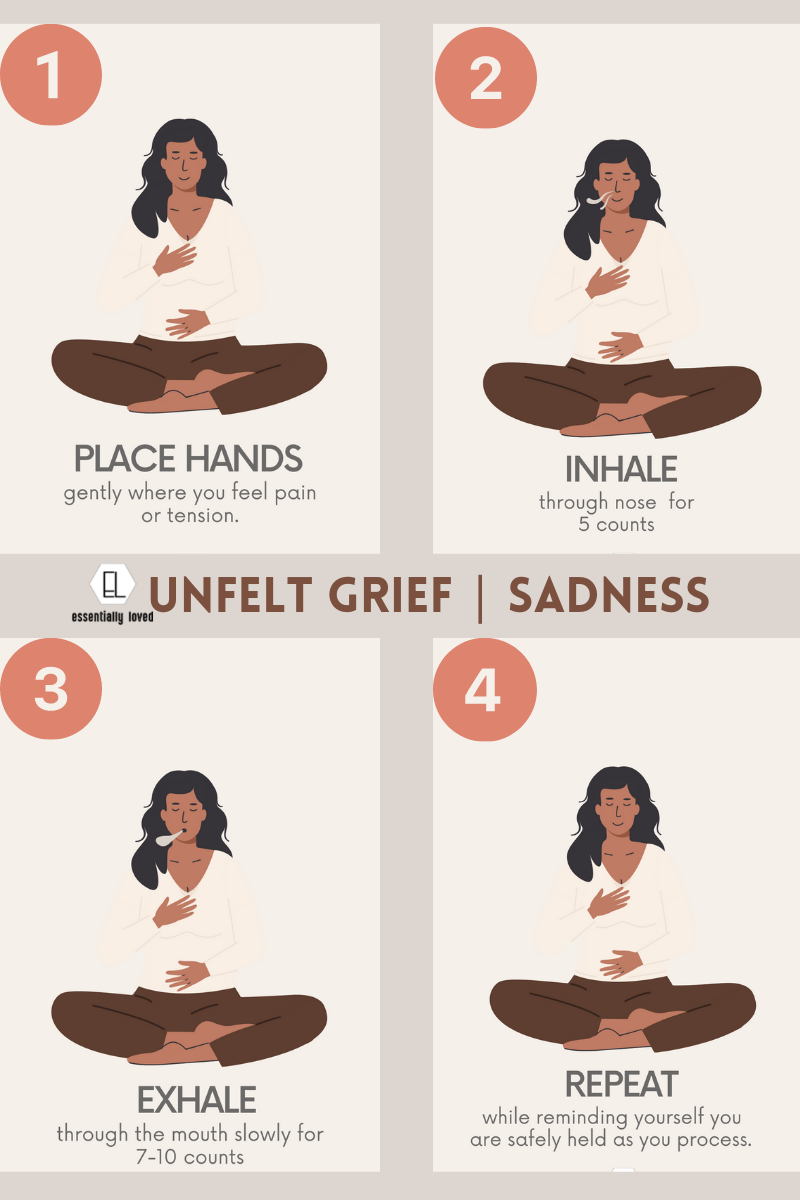
Then I grab an essential oil and put a drop in the palm of my hand and rub my palms together. While my brain is preparing to settle into the memories or situation I am doing my deep breathing. In through my nose for 5 seconds, exhale through my nose for 7-11 seconds. and repeat, and repeat, and repeat. Eventually I drop my hands, my eyes are closed and tears are streaming. (Keep the tissue close by and make sure the oils aren’t on your finger tips for the tear wipes.)
Often during this time Jesus arrives on the scene and shows me something new about it. Not always, but often. When that I like to journal down the notes.
This process seems simple enough, doesn’t it? Just wait until you make a commitment to start practicing this and you will see how powerful it is. God is a creative God and as you begin trying this He will show you new things to try and do in response.
The goal of this isn’t to circle and spin in one thought, it is to learn how to move through them. These hurts are stored in our memory banks but how we respond to them makes a big difference in how we show up in the world. If you feel stuck you may need professional help to learn some new techniques or skills. Don’t be afraid of that either. Seeking help is one of the bravest things you can do and it is such a terrific reminder that you are not in this alone. People care and want to help you!
I am also listing oils specifically helpful for processing sadness. These essential oils can do a multitude of things but today I am sharing a list of them for emotional support with sadness. Breathe is exceptionally good for this particular practice as it opens the airways and clears thinking.

Hope essential oil blend
Rose essential oil
Console essential oil blend
Citrus Bliss essential oil blend
Ylang Ylang essential oil
Siberian fir essential oil
Peppermint essential oil
Eucalyptus essential oil
These are terrific natural options for helping your mind to relax, release, feel and move through.
I’m praying for you and your process. I know God is with you in this, and so am I.
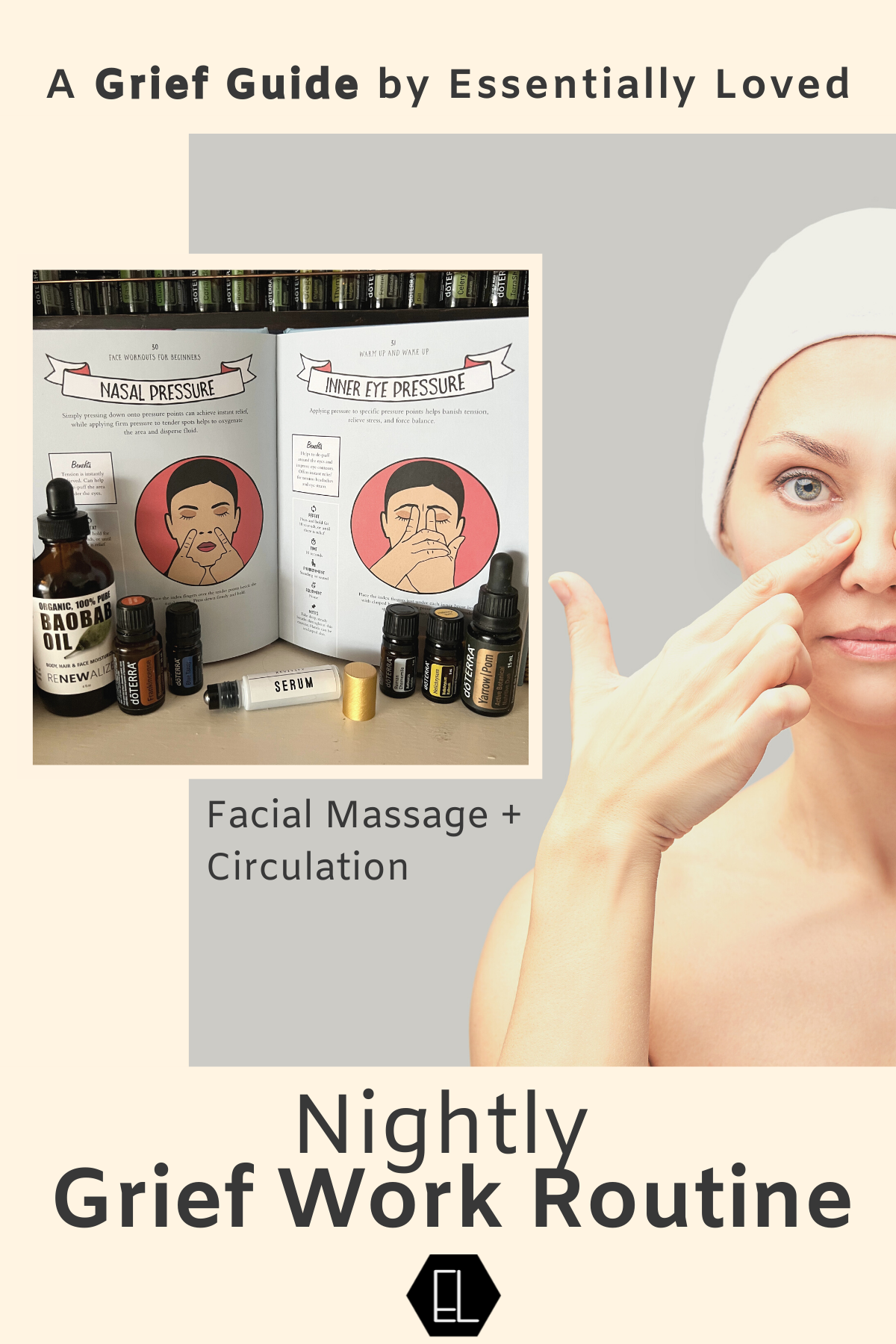
Grief Serum Recipe: a simple + kind nightly routine towards healing.

Grief is sneaky.
Grief is heavy.
Grief is exhausting.
Grief can deplete us to a place where we barely recognize ourselves.
And here is the thing…
Sometimes it wears us down to a level that not only impacts our state of mind but our bodies and potentially our belief systems as well. We may end up believing we don’t have anything in us to pull out of the pit we are currently in. That is a flat-out LIE though… even in the depths of grief, we can still continue to take steps towards healing.
That is what this post is all about. Having a super simple tool on hand that feels darn good, is relaxing, and helps you take steps towards healing.
I have found at the end of the day, during the time that pillow talk would typically happen, I needed a way to care for myself and remind myself I was going to be okay. Somehow, my evening process with this simple technique was not only caring for me but it also helped me to remember I was wanting to show up better and stronger for my future.
Note: You aren’t limited to using it at night, these tools and techniques can be used any time of day, whenever grief overwhelm strikes. Many of the oils do assist
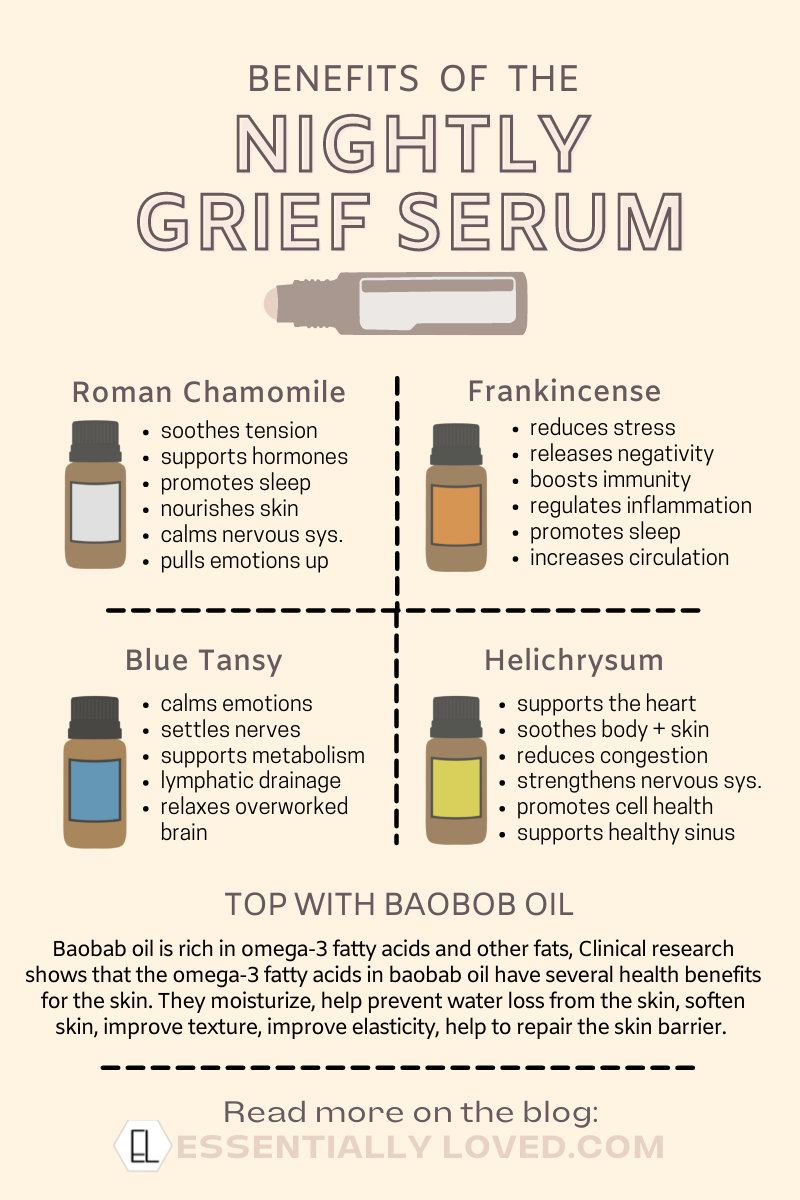
Let me tell you a little bit about why I chose these specific essential oils included in my Grief Serum Recipe. Each one provides essential oils that help provide emotional stability, promote movement throughout the mind + body, and are especially good for the skin. I am telling you these are grief-busting oils. They target the areas that grief has tried to make me out, and I am guessing you as well.
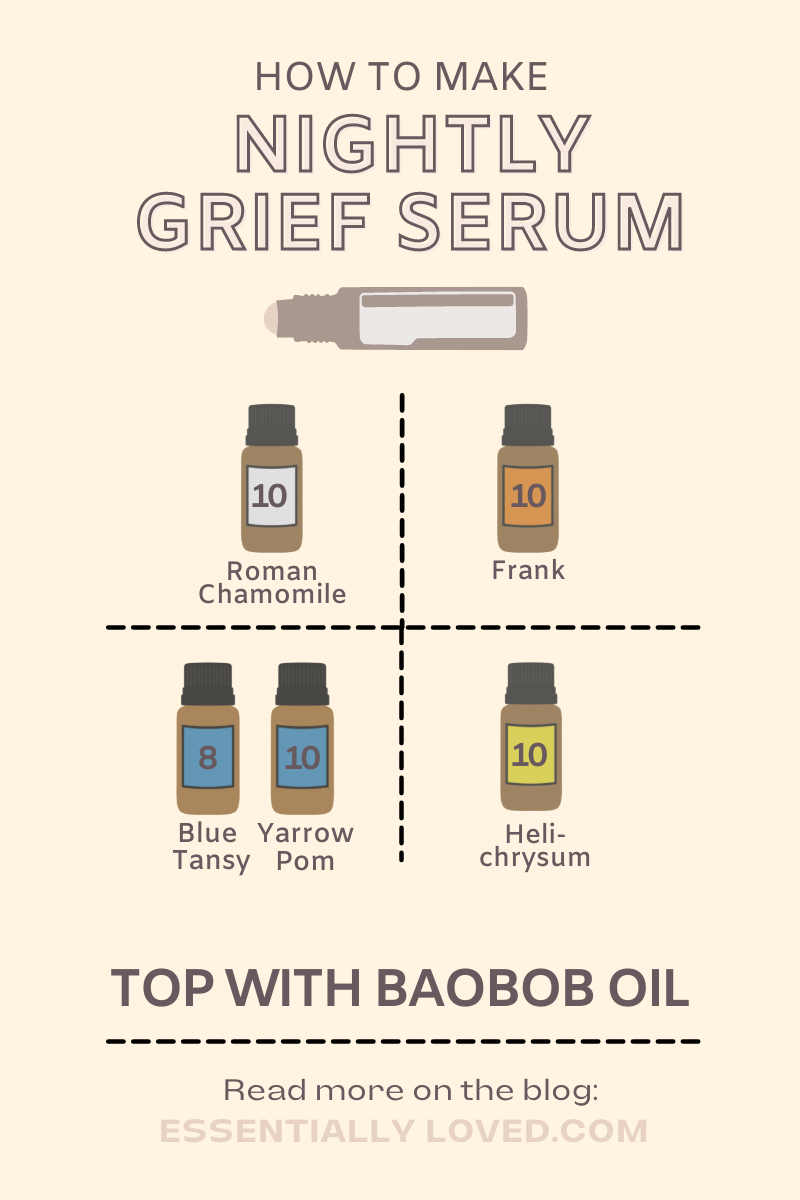
Look, I am not saying this is a “do this and BAM, IT’S INSTANTLY BETTER.” But what I am saying is it truly is a soothing technique that does a lot more than just feel good. Whether you feel them or not your body and mind are responding, and with consistent use there will be substantial change. And yes, how it does work for me instantly is in the reminder that I care about myself, I care about my future, I care about how I process my grief and move forward.
I have a graphic posted with the recipe, the number on each essential oil bottle is how many drops to put in the 10ml roller bottle, and then top with baobab oil. You can use another low-comedogenic oil but this one is an absolute favorite of mine.
Make sure you check out the graphics I have posted here to see more on the oil-specific benefits. And feel free to do your own check on each one, you will be BLOWN AWAY. So good!
If you don’t have these specific oils I have a link to grab them here: GRIEF SKINCARE OILS
This investment towards natural health is completely worth it and trust me, there are SO many additional uses for these beauties. (If you decide to grab these make sure and send me a note so I can get you my additional uses booklet.)
Items you will need:
Frankincense, Helichrysum, Blue Tansy + Roman Chamomile
10ml White / Gold Rollerbottles
There are a whole host of resources you can use to learn new techniques for self-administered face, foot, and body massage. The book I have listed above is really simple to follow along with and in the thick of heavy grief simple matters. I also have a lymphatic book that is spectacular: The Book of Lymph , if you want to get a little more specific in areas you are addressing. I use it for my sinus congestion. One more item I find really helpful is my Gua Sha stone, it is cool + smooth, I love the way it glides across my skin with the grief serum. These aren’t necessary, just for those who like to dive deep quickly. The essential oils + the baobab oil in a roller bottle, and your hands, are all you need to do the basic techniques in the beginner’s book.
I’d love to hear your feedback after trying this nightly for a few weeks. Let me know if you experience slightly deeper sleep, calmer nerves, or maybe a spark of nurture has lit for your weary soul.
Grief is hard work but it is SO worth it! I am praying this technique becomes a simple and effective tool for you to have in your grief toolbox.

5 tips for Gripping Hope through the Holidays: dealing with Grief + Emotions
She sat there, or was trying to. Even the task of sitting brought discomfort. It required stillness, and stillness allowed for ALL of the emotions to be felt. If only she could just keep doing, moving, planning….
but she was exhausted. All of her attempts at grief escape had left her depleted. Her mind + body needed rest but the physical and mental exhaust had only dropped the defensive walls down to the surface of the grief flood waters, they were brimming, beginning to splash over a little. How might she avoid the onrushing waves that were certain to crash in soon? Oh, please, not now….
She was tired. Too tired for the heavy weep of sorrow. Oh, so tired… but oh so unsettled. Letting the grief flow freely was still so difficult, so painful.
But so was avoiding it, just a different kind of steady pain that she barely recognized was happening. Recognized or not, it was crippling her. It was taking her out, little by little, day by day. She had to find a way…
And so she did, and she still does. Because grief is certain to come and go.
But now, most of the time, she knows when to welcome it, and how she can do that best.



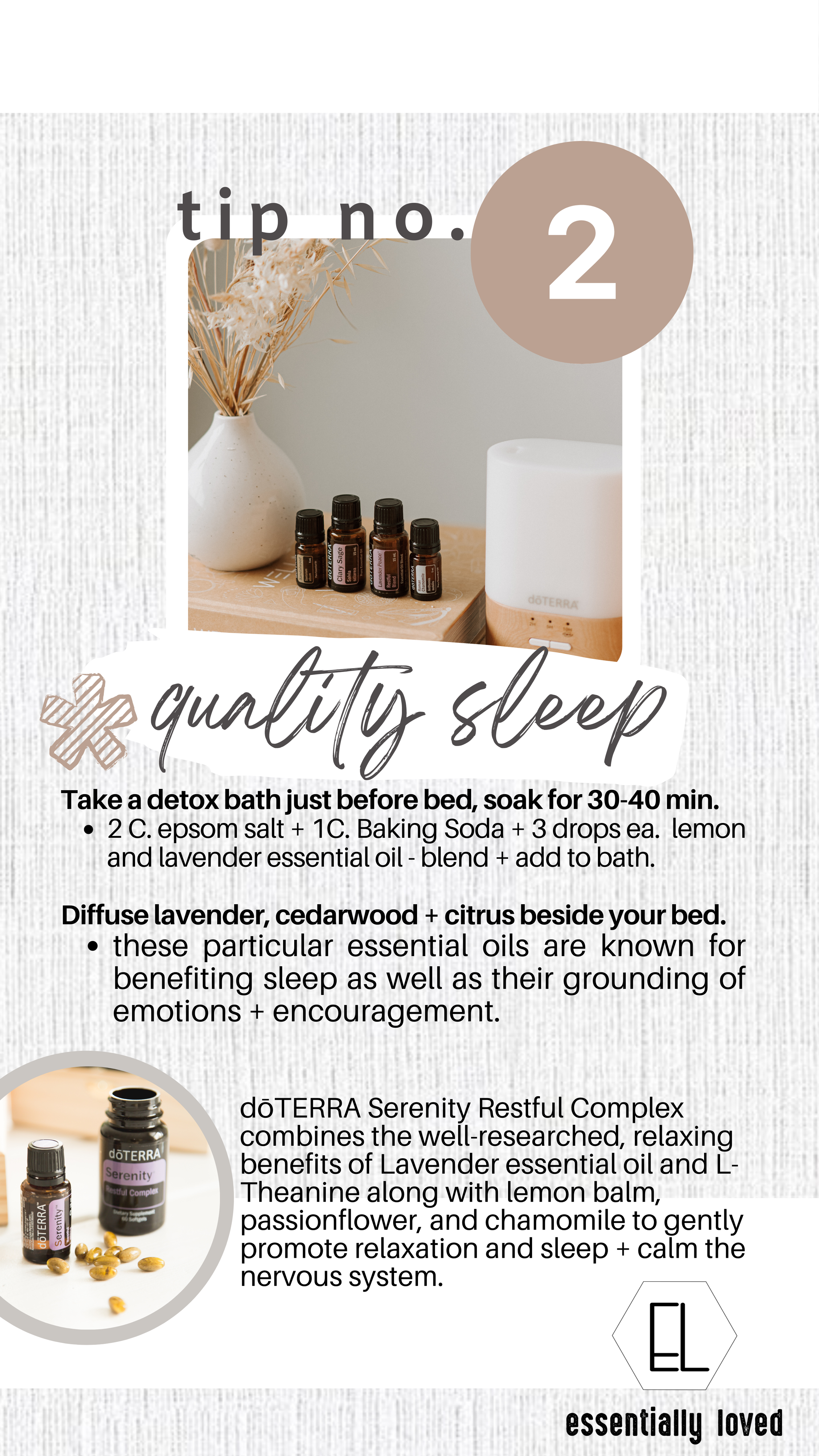



Let’s see if some of the tips in the slide show above help you. I tried to think of some of the biggest issues I have faced coping with grief during the holidays. It’s challenging, I won’t lie. But, we do have options that can help us manage better, help us find our way through it with a little more ease. It isn’t easy but it feels better after we do it. Honest!
I created a mini-book for you to help to move through the holidays. It has more detailed information and access to some of what I use regularly in my Grief Toolbox. You can click the link HERE for my HOPE for the Grieving Heart Mini-Book. It is only $6.95, up for a very limited time at just a fraction of the cost that my physical book will be. So grab it while you can!

The Unexpected in Widowhood: Learning to trust.

My mornings are such a mix these days. They range from waking with head pressure, sometimes angst, maybe a song, all the way to out and out enthusiasm. But I am not so far away from the brutal slap of widowed reality + gasp for oxygen mornings, sleepless nights, to forget their sting. They were my unwelcomed morning ritual for, well, far too long to count. I will say they were there long enough, they were consistent enough for me to be able rise and recognize the feeling of freedom without their presence. And today it has brought to me a place of such deep gratefulness.
Today was one of those days. This morning I woke up with words of thanks spouting from my lips. I found myself standing up + speaking out loud from my heart:
“God, I LOVE you. Thank you for that. Thank you for loving me and for helping me to know you. Like really, KNOW you and TRUST you. Thank you for having a plan for my life. A good plan. Thank you for the people you have put around me in my life, to help remind me and to spur me on. Thank you that you are teaching me that I can trust myself .“ SCREECHING HALT…. ummmmm, wait … WHAT did I just claim? And when did that happen?
See, since Dave passed away this sneaky little distrust in myself began to grow. As time continued to separate me from the life I had lived with my husband I found myself questioning more and more of my abilities: my decision-making processes, my feelings, the filters I run info through, my ability to show up. I began to feel this weird weight of scrutiny pressing on me. And I found myself wondering just where did this mental onslaught stem from? Because I was pretty sure a lot of it was in my head.
Through time + much thought, I have come to the conclusion that there were some key voices that spoke into the spaces of my falsely held beliefs.
1- Well-intentioned people questioning my process.
2- The void where his voice once spoke to bring balancing opinions + thoughts.
3- History. All the voices of my past failures magnified by the risk of facing future ones alone.
4- The whispers of the enemy, “You can’t do it.”
The sheer volume of these voices spinning on repeat in my head would hit me at different times throughout the day, although I will say this… I think they were probably on constant replay. I think I was just busy putting every ounce of my subconscious mental energy into drowning them out. However, it took its toll + somewhere between 2-4pm my brain would just want to shut off with my body closely wanting to follow. About that time the nerves would fire up to keep me in motion until bedtime. And throughout the evening and upon rising I would have a spontaneous electrical dance responding to those voices until I stood up to drown them out that following morning. And repeat.
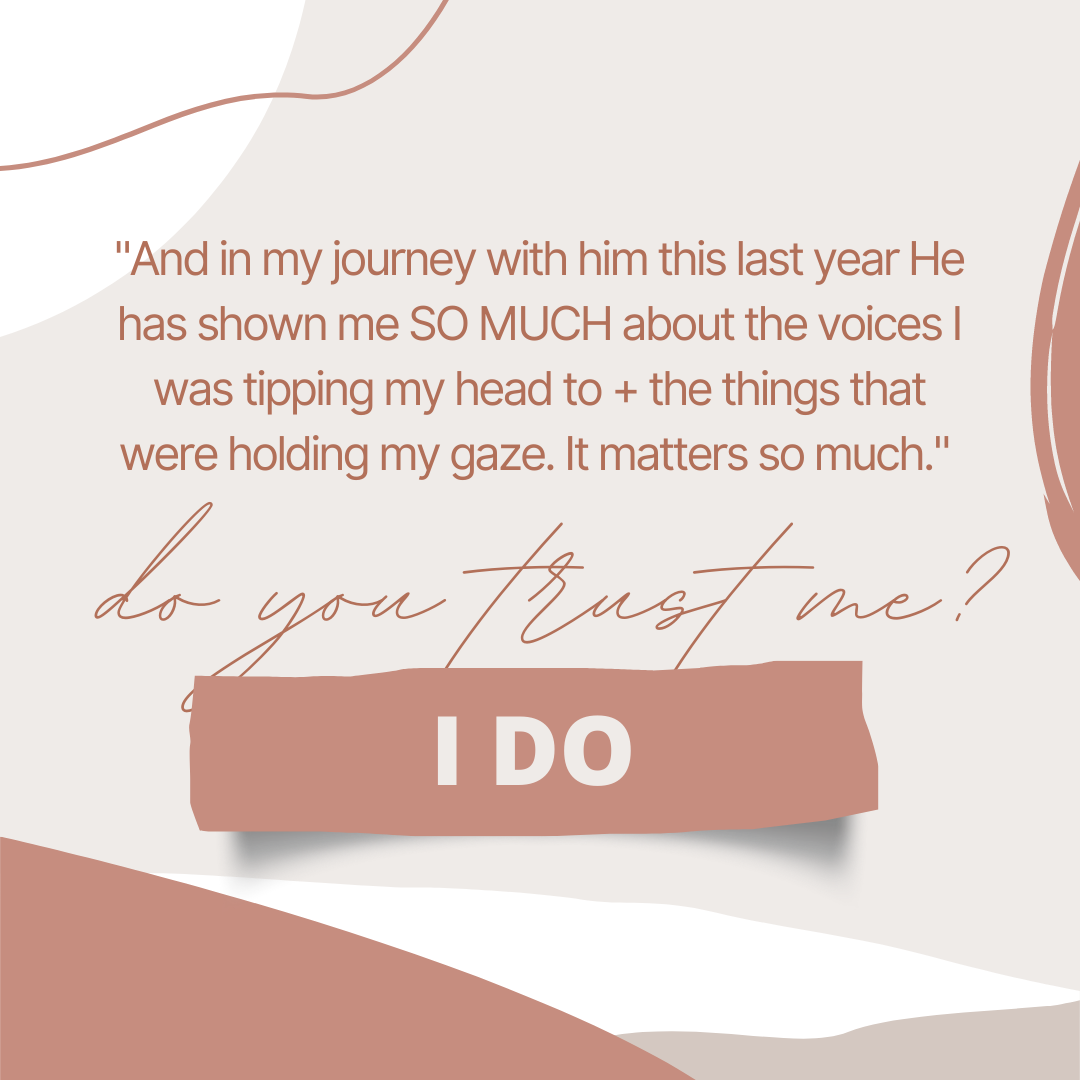
But somehow scattered here and there I found space to sit with Jesus,
even when I didn’t feel like I had a drop of energy to personally show up. My sordid past had already proven His immense love for me + I knew I could trust him to show up even when I couldn’t muster much strength. I just needed a willing heart to try.
And as I started to implement some simple steps with my Being Known time I would find Jesus asking me morning after morning… “I know you don’t trust yourself, but DO YOU TRUST ME?” Yes, Jesus, I do, completely.” And in my journey with him this last year He has shown me SO MUCH about the voices I was tipping my head to, the things that were holding my gaze. It matters much. And with his simple questions + his deep love, my mind has been able to identify some of the faulty wiring + naturally I am beginning to respond out of more of his truth.
In the course of that, I have fallen SO deeply in love with Jesus, right in the thick of my painful process. The very thing that took a swing at me with the intention of taking me out resulted in shifting my position + opening my view to THE ONE who would steady my stance by wrapping his loving arms around me, holding me tightly, looking straight into my eyes, while asking me the question over and over again until I believed it to my very core:
“Kim, do you trust me?”
I do. If ever I trust anything, it is YOU!
My journey is still long. I have much to still discover BUT for today I am so grateful to recognize that although I won’t ever have all the right answers on my own, I do know the ONE who does. And we are tight, like really tight. In fact, he adores me.
This song:
LOVE YOURSELF
by Justin Bieber + modified lyrics by Tanner Townsend, it gets me every single time I listen to it. Close your eyes + wrap the words around your heart and mind.
“For all the times that you feel so alone
And when you don't know where to turn or to go
You think you're too far gone, you've made your last mistake
You think I'm lying test me, kneel down and pray
'Cause Gods got a plan for you
Listen to the spirit there's too many
Different voices, block out all the noises
I'm singing that I know it's true
And if you think you're worthless, I just want to help you know that
You're still good, don't look back
And the Father loves you, and he loves everyone
And I'd invite you to pray through His Son
We get so caught up in our day, we forget to kneel and pray
Yes I know that you are never on your own
If you could see the way He sees your soul
Then maybe you could learn to love yourself
And if you start to hear the still small voice
Then maybe you could go and trust yourself
And if you start to feel that all your hope is lost
Remember Jesus died on Calvary's Cross
He suffered all the pains and hopelessness you'll see
So you can break the chains and start to be free
'Cause Gods got a plan for you
Listen to the spirit there's too many
Different voices, block out all the noises
I'm singing that I know it's true
And if you think you're worthless, I just want to help you know that
You're still good, don't look back
And the Father loves you, and he loves everyone
And I'd invite you to pray through His Son
We get so caught up in our day, we forget to kneel and pray
Yes I know that you are never on your own
If you could see the way He sees your soul
Then maybe you could learn to love yourself
And if you start to hear the still small voice
Then maybe you should go and trust yourself
For all the times that I know, you feel small
Just take His hand, and He will help you stand tall
And if you hold fast to the rod and don't lose sight
Then you can know that it will end up alright
And the Father loves you, and he loves everyone
And I'd invite you to pray through His Son
We get so caught up in our day, we forget to kneel and pray
Yes I know, that you are never on your own
If you could see the way He sees your soul
Then maybe you could learn to love yourself
And if you start to hear the still small voice
Maybe you should learn to love yourself”

Good Grief, what does it even look like?

I wish someone would tell me what GOOD GRIEF looks like. I take that back. No, I don’t! And here is why…
It doesn’t look like one particular thing. It doesn’t look the same from person to person. It doesn’t look the same day to day, or even hour to hour, or sometimes even minute to minute. Show me someone who loved deeply and lost, and I will show you yet another way that grief will show up on the scene. It is complex and individual to the person. And…. long lasting for most.
And MOURNING… the act of processing the deep abiding, long-lasting, grief. That is another thing entirely. Show me people who do that well and I will show you the most raw, revealing, public, tear your sackcloth, scream in the streets display of wailing you have ever seen. Stop and really think on that for a minute, how would that make you feel to witness? Um… perhaps too emotional for you? I mean, what would you do with that? Could you watch it comfortably from afar? Would you gently step up and touch it? Would you try to approach and hug it away? OR would you shift your attention elsewhere? I think internally your heart would quicken its step a little at that emotional exposure. Are they mad (as in out of their minds)? Do they need emergency assistance? Why can’t they control themselves? Many would want to do something about it to make it stop because it is just plain uncomfortable. And it should be…and it will be. And so what is a person going through it to do? Our culture holds many silent beliefs about this.
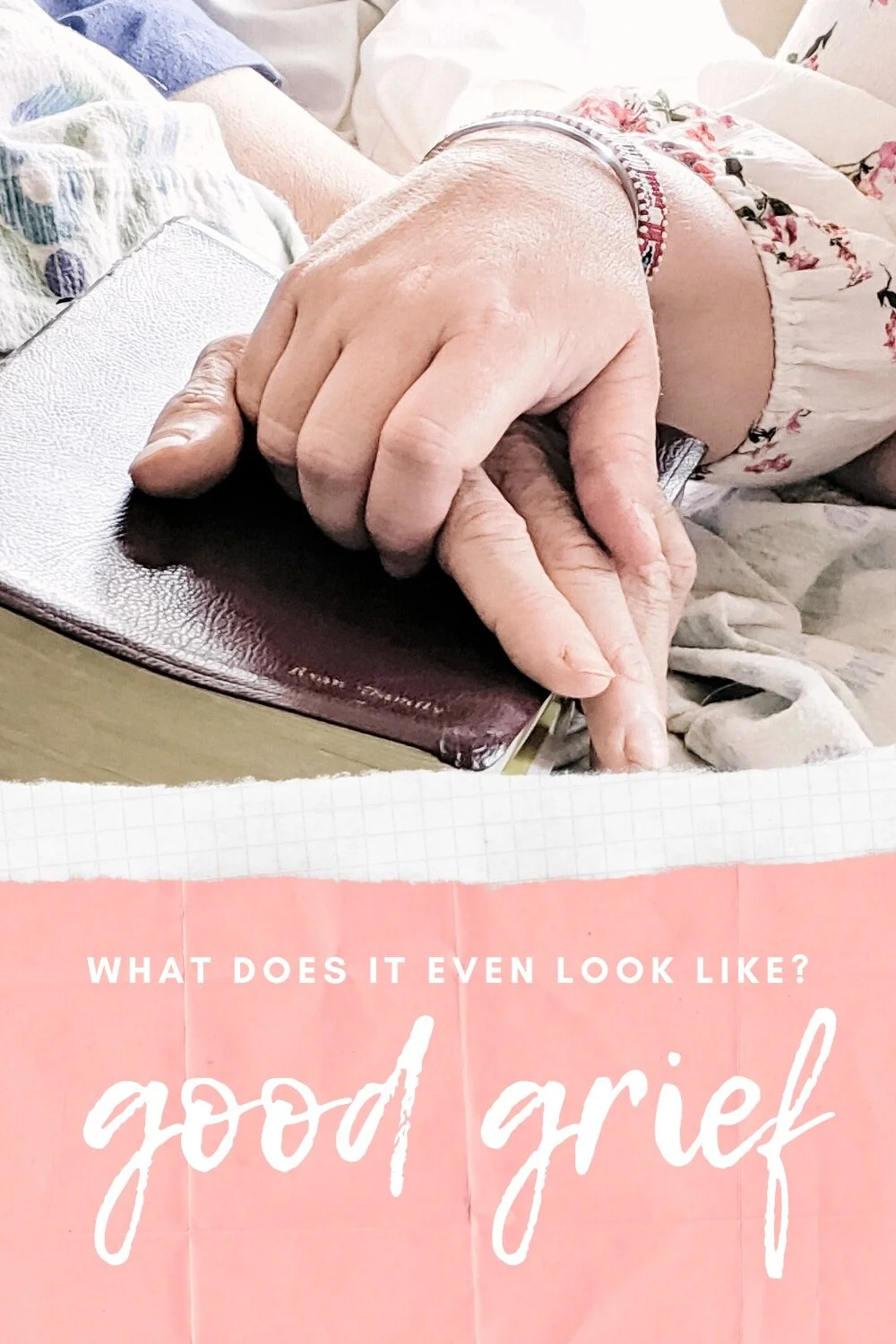
Okay, let’s open this door for a second…should those grieving “contain and control” the majority of the time? Is it a private matter? And let’s talk about the speed of it. Should it change its appearance rather quickly? Like would it be appropriate if the deep, incapacitating grief lasted a month or maybe two tops, following the loss? Then around 2-3 months we should probably expect the person to start engaging more and stepping back into the “real world” as many say. Oh, but they still seem and act different, perhaps guarded, distant, gloomy. Well, by six months surely they will be well on their way back to normal. And by a year… BAM… rolling forward with serious strides… in fact… some may say the wounds of grief should be basically healed at this point.
Oh friends, I am sitting here telling you that (let me count) it has been eight months since my husband passed and I am not sure I feel like I have taken one step towards healing. In fact, I am feeling the depth of the loss more deeply. It’s funny how the reality of all that the loss touches takes serious time to press into your thinking bank. Memory serves us well, until it doesn’t. My memory still tells me from experience he is going to walk through the door, that I need to check with him, that he is the expert and I need to wait for his opinion, that I am hurting and he is the one physical space where I can rest and feel comfort…. that last one is literally killing me. The VERY thing I need him most desperately for (comfort) is present because I NEED him most (first place besides God in my life). That one makes me feel like I am going mad. Reasoning ones absence in our lives doesn’t come easy. It takes time, a ton of different emotions, a bazillion spoken (or written) words, and even more thinking through. It hurts to think, talk, do and so our brains naturally do their very best to avoid it. We are literally fighting within our heads ALL THE DAY LONG. The brain does all it can to avoid the pain and at the same time it is screaming at you about your inabilities. Inability to focus, to do, to remember, to work through it. It is like 10,000 gears are working in different directions and at one no certain point they just end up jamming. Shutting down. Frozen. This typically happens to me in the late afternoon. I find myself DONE and ready to just close my eyes, sleep the rest of the day, or just turn everything off around me. I am literally exhausted mentally and physically with the simplest of things seeming impossible to accomplish. My brain just won’t work anymore.
This leads me into my current stage of discomfort with my grief. I am BEYOND ready for this pattern to be over, and to move on. I have things to do, I need to earn an income, I need to flipping just plain feel happy. I fear I am exhausting my friends, and I am certainly exhausting myself in the trying. But one can’t just give up… I must keep striving.
I do however trust the good, some relief from grief, is coming. I cling to that hope. A day will come when I have held more happy than sad within my minutes. I will always remember, I will always be sad it went how it did, but I will also look forward to the new. For now… I’ll just continue to feel and process until that day comes. So that the day will come.
And for those of you who are walking alongside someone who is grieving, or even approaching someone who is grieving. You don’t have to understand it. In fact, you probably can’t. But you can have immeasurable grace and love for them. Ask to help them with tangible tasks. The collections of those are often the most overwhelming. And listen… don’t be afraid. Let them RANT and just listen, and care. As they talk they are processing it out themselves. Fill the space with love and grace.
Be well,
Kimber