Why Some Questions Make Widows Feel Defensive or Insecure.
Widows are often asked questions about their grief that carry a hidden undercurrent with them. Here’s why some questions can feel painful—and what widows wish people understood.

Widows, can we talk about something for a minute?
Have you ever been asked a question about your grief and suddenly felt your body tighten?
Maybe your chest pulled inward.
Maybe your mind started racing.
And suddenly you felt defensive.
Or insecure.
Not because your grief is playing out wrong.
But because something about the question made you feel like you needed to protect yourself… or explain yourself.
Later you might find yourself wondering:
Why did that question bother me so much?
Why did I suddenly feel like I had to justify my grief?
If this has happened to you, you’re not imagining it.
And you’re not overly sensitive.
There is actually a reason this happens.
Let’s talk about it.
Sometimes the Question Isn’t Just a Question
Most people who ask widows questions have no intention of saying anything hurtful.
They care.
They’re curious.
They’re trying to understand something they have never walked through themselves.
But our culture quietly carries a lot of beliefs about how grief is supposed to work.
Many people have absorbed the idea that grief should gradually resolve over time. That eventually you should return to the person you were before the loss. That strong faith should make grief easier. That staying busy or focusing on the positive will help someone move on.
That healed grief should look like productivity, activity, and engagement with life again.
Some even believe grief is simply a mindset that can be managed or controlled if someone tries hard enough.
Most people don’t realize those ideas are shaping the questions they ask.
But boy, do widows feel them.
Sometimes before their mind even has words for why.
And suddenly the question doesn’t feel like curiosity anymore.
It can feel like evaluation.
Like someone is quietly measuring your grief.
Widowhood has a way of exposing how little language our culture actually has for loss.
Sometimes what widows feel underneath these questions is a quiet pressure that sounds something like:
Why can’t you just…
Why can’t you just move forward.
Why can’t you just stay positive.
Why can’t you just start living again.
But grief isn’t something we simply “just” our way through.
Why It Can Land So Deeply
When you lose your husband, grief doesn’t just touch your emotions. It reaches into absolutely everything.
Your body.
Your nervous system.
Your brain.
Your identity.
Your routines.
Your sense of safety.
Your place in the world.
Years of shared life created deep attachment.
Your brain wired in his voice, his presence, his rhythms.
Your nervous system learned to regulate alongside his.
Your identity formed around a life built together.
So when a question carries assumptions about how grief should behave, it can feel like something sacred is being questioned:
your love
your loyalty
your healing
your story
It’s no wonder your heart sometimes reacts quickly.
That reaction isn’t because of weakness, or confused thinking.
It’s the echo of attachment and love.
Sometimes what hurts about the question isn’t the actual words themselves.
It’s the measuring stick hidden underneath them.
Questions That Can Hit Widows Hard
Widows hear a lot of questions after loss.
Some are thoughtful and caring.
Others are simply people trying to understand something they’ve never experienced.
But sometimes a question carries an undercurrent — an assumption about how grief is supposed to work.
And when that happens, the question can land harder than the person asking may realize.
“How long has it been now?”
The undercurrent of the question:
Shouldn’t you be further along by now?
The truth widows know:
Love does not follow a calendar, or a timeline, or stages.
Grief may change shape over time, but it doesn’t disappear simply because months or years pass.
“Are you doing better?”
The undercurrent of the question:
Are you progressing the way I think healing should look for you?
The truth widows know:
The loss will never feel good or neutral.
And performing or pretending like it doesn’t bother us anymore can make us feel like we are betraying ourselves.
Some moments feel lighter.
Some moments feel heavy again.
Both can exist at the same time.
Doing better for us is being able to honestly communicate our grief without worrying about how it makes other people feel.
“Have you thought about dating?”
The undercurrent of the question:
Isn’t it time to replace what you lost?
Or to move on so you aren’t so sad?
The truth widows know:
Love and attachment do not simply reset.
There is no replacing the life and person we lost.
A new relationship doesn’t erase the pain or restore the person we were before loss.
Sometimes it feels like people believe the “old us” will return if we have a partner again.
But widowhood changes a life in ways that cannot simply be undone.
“Don’t you want to move on?”
The undercurrent of the question:
Are you stuck in your grief?
Do you like feeling this way?
Why can’t you just…
The truth widows know:
Grief isn’t something you choose to stay in.
It’s something you slowly learn how to live with.
And moving forward and carrying the person you love can happen at the same time.
“Do you still think about him every day?”
The undercurrent of the question:
Shouldn’t the attachment be fading by now? Shouldn’t you be further along?
The truth widows know:
We don’t ever want to forget them. In fact, at times we are afraid we will forget them.
“What would your husband want you to be doing right now?”
or
“How would your husband want you to be handling this now?”
The undercurrent of the question:
Are you honoring him by how you’re grieving?
This question can feel deeply insensitive to the reality we are living in.
Our entire grief experience exists because the person we built life with is gone.
Being asked to consider what they would want from us now can make the conversation shut down almost instantly.
It asks us to consult someone we can no longer turn toward in life.
The truth widows know:
The voice we most wish we could hear is the one we can no longer ask.
Widowhood forces us to learn something we never wanted to learn.
How to make decisions.
How to move through life.
How to think and choose on our own again.
Without the person we used to do life beside
Responses to Keep on Hand
Widows, sometimes the most helpful thing we can do when a question lands heavily is simply slow the conversation down.
Not with anger.
Not with withdrawal.
Just with clarity.
You might say something like:
Would you mind reframing that question a little? Sometimes my grief can color how I hear things, and I want to make sure I understand what you’re really asking.
Before I answer, can I ask what you’re hoping to understand?
Can you tell me a little more about what you’re asking?
That question can carry a lot underneath it. Can you tell me a little more about what you’re wondering?
Help me understand what made you ask that.
These responses don’t shut someone down.
They simply slow the moment down.
And sometimes that small pause is all it takes for the conversation to shift from assumptions to understanding.
One last thing I’d love for you to hear
Widows, many questions people ask about grief are not really questions.
They are beliefs about how grief should behave.
But grief does not follow cultural expectations.
Grief follows love.
And the depth of your grief is not evidence that you are doing something wrong.
It is the exact opposite… evidence that love existed.
Be Well,
Kimber

Understanding Grief After the Loss of a Husband

Many widows experience a complicated emotional and neurological response after the death of a spouse. Grief after losing a husband can affect the brain, nervous system, identity, and daily life in ways that many people do not realize. Researchers studying bereavement and attachment have found that grief can impact memory, concentration, emotional regulation, and the body’s stress response.

Widows often describe feeling misunderstood when others expect them to “move on,” stay positive, or return quickly to their former life. The truth is that grief after losing a spouse is not simply sadness. It is the result of deep attachment, shared life rhythms, and years of emotional co-regulation with a partner.

Because of this, questions about grief can sometimes carry unintended pressure. Many widows report feeling defensive or misunderstood when people ask if they are doing better, when they will move on, or whether they are honoring their spouse through how they grieve.

Learning about the impact of grief on the brain, body, and emotional life can help widows feel less alone and can help friends and family better understand what someone experiencing deep loss is actually going through.

This article explores why certain questions about grief can feel painful to widows and what many widows wish people understood about loss after the death of a spouse.7 gift ideas to help widows feel seen on Valentines Day.
Valentine’s Day can be especially hard for widows — not because love is gone, but because it remains. These seven meaningful ideas offer gentle ways to help widows feel seen, understood, and cared for in their grief.

valentines day is very hard for most widows - here are 7 ideas to help her feel seen, loved and understood.
The world celebrates love loudly on Valentine’s Day.
Hearts fill storefronts. Couples fill restaurants. Messages of romance and togetherness fill the air.
Meanwhile, widows carry the deep weight of loss — and the love that still remains.
Their love didn’t disappear when their spouse died. It didn’t diminish or fade. It continues, woven into daily life, memory, and the body itself. On a day designed to spotlight romantic love, that absence can feel excruciating and extra lonely.
Valentine’s Day can be one of the hardest days of the year for widows — not because love is gone, but because it is everywhere and nowhere at the same time.
Yet even when the day itself hurts, love can still be shown.
Not loudly. Not awkwardly. But wisely and gently — in ways that help widows feel understood, held, loved, and seen.
7 Meaningful Valentine’s Day Gift Ideas for Widows
What each gift quietly says: “I understand your grief.”
These are not gifts meant to cheer someone up or move them forward.
They are gestures that say, I’m not afraid of your grief. I know love didn’t end.

A heart locket can honor the love a widow still carries, even on a day that highlights absence.
1. A Heart Locket (With a Photo Inside)
What this gift says:
“I understand that your love didn’t end — and I’m not asking you to hide it.”
Widows often feel the world expects them to loosen their bond, to hold their love more privately. A heart locket does the opposite. It honors continued connection.
Why it helps:
Grief research affirms that maintaining a continuing bond with a loved one is healthy and stabilizing. Carrying a photo close can be grounding on days when absence feels sharp and disorienting.

Peace Lily Gift for Widows - great air purifier in the home reminding her to breathe.
2. A Living Plant (Peace Lily or Prayer Plant)
What this gift says:
“I understand that care needs to be gentle — and ongoing.”
A peace lily symbolizes quiet endurance and peace. A prayer plant folds its leaves at night, resembling hands in prayer — opening and closing in a daily rhythm that mirrors grief itself.
Why it helps:
Living plants communicate ongoing care without urgency. Many also improve indoor air quality and humidity, subtly supporting breathing and comfort. They offer continuity when life feels fractured.

such a beautiful reminder for a widow that many tears are expected with this kind of loss and they are okay.
3. A Tear Bottle or Tear Jar
What this gift says:
“I understand that your tears matter — and don’t need to be fixed.”
The image of a tear bottle comes from Psalm 56:8:
“You have kept count of my tossings; put my tears in your bottle.”
In Scripture, tears are not dismissed or rushed. They are seen, gathered, and remembered.
Why it helps:
Grief grows heavier when tears feel inconvenient or unsafe. A tear jar gives sorrow a place — a quiet witness when words are unavailable. Crying can help release built-up stress and support emotional regulation in the body.

Valentines day gift idea for widows with written words of truth reminding them throughout they day their level of grief is understood.
4. A Framed Word or Short Verse
What this gift says:
“I understand that some days words are hard — so I’m not giving you many.”
A single word like Loved or Held, or a short verse, doesn’t demand reflection or response. It simply rests in the room.
Why it helps:
Grief can overwhelm cognition. Visual anchors reduce mental load and offer reassurance without requiring effort — especially on emotionally heavy days.

a cozy wrap for a widow to feel held in the depths of her grief.
5. A Cozy Wrap
What this gift says:
“I understand that grief lives in your body, not just your heart.”
Many widows describe feeling physically unsettled or exposed, especially on days that amplify absence.
Why it helps:
Warmth and gentle pressure signal safety to the nervous system. A wrap offers containment when emotions feel uncontained — comfort without conversation.

a calendar, organizer, and small topical notebooks to keep a very simple and organized system to help with grief brain fog.
6. A Leather Traveler’s Notebook
What this gift says:
“I understand your mind is carrying too much — and you need one place to put it.”
Grief fragments attention. Thoughts, tasks, reminders, questions — everything floats.
Why it helps:
A traveler’s notebook acts as a second brain: one place to organize thoughts, lists, plans, and reminders. Sections are easy to find, reference, and later transfer into calendars or daily plans — reducing stress during grief fog.

a diffuser with essential oils or a candle to bring fresh scent and peaceful calm into the home, when life feels lonely for widows.
7. A Diffuser or Candle
What this gift says:
“I understand that your emotions arrive before words do.”
Valentine’s Day can feel loud — emotionally and sensorially.
Why it helps:
Scent and soft light reach the limbic system, the part of the brain involved in emotion and memory. Calming scents can regulate breathing, lower anxiety, and offer steadiness when feelings rise quickly.
What Matters Most
Valentine’s Day doesn’t need to be avoided with widows.
It needs to be handled gently.
The most meaningful gifts don’t try to make grief smaller or quieter.
They acknowledge love, honor loss, and offer care without expectation.
Sometimes the greatest gift is simply this — letting them know:
You are seen.
Your love still matters.
You don’t have to carry it alone.

valentines day ideas to help see a widow where her pain exists on valentines day.
Valentine’s Day can be especially difficult for widows because it highlights what has been lost while the love itself remains deeply present. While the world celebrates romance and togetherness, many widows carry both enduring love and profound absence at the same time. Images like these reflect that quiet reality — the stillness, the weight, the longing — without needing words. They help name what is often unseen: that a widow’s grief is not about a lack of love, but about loving fully in a world that no longer knows where to place it.
When Grief Makes Your World Small: The Healing That Happens When You See Someone Else’s Story
Grief makes your world small, tight, and closed in. But something sacred happens when you step into someone else’s story. This raw, honest reflection invites widows into healing through empathy, witness, and the gentle ways God moves through our brokenness.

There’s something I don’t think most people understand about grief — especially the kind that comes after losing your person.
It makes your world small.
Tight.
Closed in.
You don’t do it on purpose.
You’re not trying to shut people out.
It just… happens.
Your body is trying to survive.
Your mind is trying to make sense of a life that seemed to break down overnight.
And your spirit is trying to remember how to breathe in a world that suddenly feels unsafe.
So you fold inward.
You get quiet.
You stay in your head.
You live inside this awful ache because that’s the only place that feels real anymore.
But here’s the thing — and this is the part I wish I could sit across from every single widow and share:
There is something deeply healing that happens when you step outside your own story long enough to see someone else’s.
Not with effort.
Not with “I should.”
Not with pretending your grief isn’t heavy.
But with honesty… and a little courage… and the tiniest willingness to look up.
When I was drowning in my own grief — truly drowning — the only thing that helped me keep moving forward was entering into someone else’s story. Sitting with their pain. Seeing their grief truths. Letting God's love move through me even when I felt like I had nothing left.
And it’s wild, honestly… because it shouldn’t make sense.
How can pouring out love when you feel empty bring healing?
How can holding space for someone else while you’re shattered do anything but drain you?
But it doesn’t drain you.
Not when it’s real.
Not when you’re not forcing anything.
Not when it’s done in response to Jesus.
It actually ignites something.
I’ve felt it happen in real time — that quiet spark in my chest, that soft reminder that my story is not done, that God is somehow using my brokenness to breathe life into someone else.
That’s the Holy Spirit.
That’s love in action.
That’s what happens when grief meets compassion.
And there’s real science behind this, which honestly still amazes me.
When we enter someone else’s story with empathy — especially in shared suffering — the brain releases oxytocin. This is the “bonding” hormone. The “you’re safe with me” hormone. The “you’re not alone” signal our bodies desperately need.
It lowers cortisol — that stress hormone that grief sends skyrocketing.
It softens the nervous system.
It opens the heart and you begin to breathe again.
It reminds you that you still have feelings.
Still have love.
Still have the ability to give something meaningful even when you feel emptied out.
And this part is important:
This isn’t bypassing your own grief.
This isn’t minimizing your pain.
This isn’t trying to pretend you’re okay.
It’s the opposite.
It’s God meeting you in the raw center of your sorrow and saying, “Watch what we can do…”
Because when you step into someone else’s story — even for a moment — you’re not abandoning your own.
You’re letting Jesus shine a bit of His love through the cracks that have felt useless or unworthy.
And scripture backs this.
John tells us that perfect love casts out fear — not your strength, not your resilience, not your best attempts to be okay… love.
God’s love through you.
God’s love toward you.
God’s love weaving stories so no one has to sit in the dark alone.
I used to think I needed to “heal first” before I had anything to offer.
But that was a BIG FAT lie — a straight-up lie from the enemy.
The truth is this:
Love doesn’t stop, get bruised, or pause for you to be healed in order to flow through you.
God doesn’t wait for your story to be tidy and neat before He uses it.
And grief doesn’t disqualify you from being someone who brings light into the world.
In fact… your grief might make you more tender, more aware, more present than you ever were before.
You don’t have to feel whole to offer love.
You just have to be willing.
And even that willingness?
He gives that too.
The Sacred Work of Bearing Witness
One of the most powerful things I’ve learned in grief is this:
You don’t have to fix someone to love them.
You just have to witness them.
Bearing witness is holy ground.
It’s looking at someone else’s pain without trying to tidy it.
It’s listening without offering answers.
It’s saying, with your presence, “I see you. You’re not alone in this moment.”
And something surprising happens when you do this — even while you’re grieving yourself:
You remember that your heart still works.
You remember that God is still moving.
You remember that tenderness still lives inside you, even on the days you feel numb.
Bearing witness isn’t about giving out what you don’t have.
It’s about letting your story sit beside someone else’s story and trusting that God will do the weaving.
Because grief convinces us that we’re useless.
That we’re too broken to show up for anyone else.
That our pain disqualifies us from offering comfort.
But the truth?
Grief has trained your heart to recognize suffering.
You see it differently now.
More clearly.
More honestly.
More compassionately.
Your presence carries weight — not because you’ve healed, but because you understand.
And when two hurting hearts sit side by side, Jesus sits with them.
Not to erase the grief, but to breathe life into the space between.
That’s bearing witness.
And it is both a gift to others and a healing balm for you.
5 Practical Ways to Enter Someone Else’s Story Without Overwhelming Yourself
These are gentle, grief-friendly ways to show up without abandoning your own emotional limits.
These are the steps I lived.
The ones that kept me soft when life seemed determined to harden everything.
Offer Presence, Not Solutions
You don’t need answers.
You don’t need wisdom.
You don’t need to say the right thing.
Just offer a moment of presence.
“I’m here. You don’t have to walk this alone.”
Presence heals what explanations never will.Let Your Listening Be Slow and Unrushed
When someone shares their pain, don’t sprint to the ending.
Sit with them in the middle.
Slow listening says, “Your story matters. You don’t need to be faster for me.”Share Only From Your Scars, Not Your Open Wounds
You don’t have to match their pain with your own.
But a gentle “I understand some of this” offers solidarity instead of comparison.Keep It Small, Simple, and Honest
Showing up doesn’t have to be big.
A voice memo.
A five-minute conversation.
A text that asks for nothing in return.
Small acts carry big presence.Let Jesus Fill the Space You Don’t Have Words For
Whisper, “Jesus, be here.”
He fills what you cannot.
He holds what neither of you can carry alone.
Here’s the beauty widows rarely hear:
Showing up for someone else in small, honest, grief-soft ways doesn’t empty you…
It grounds you.
It connects you.
It reminds you that your life still holds purpose.
That your love is still needed.
That God is still moving through your tired, hurting heart.
You are not useless.
You are not too broken.
You still carry something sacred to give — even now.
Especially now.
If You Want to Step Into Another Story With Me
One of the things that surprised me most in grief was how healing it was to enter into stories far beyond my own — especially the stories of widows in Kenya and Tanzania who carry both unimaginable weight and remarkable strength.
Their lives, their resilience, their faith… it changed something in me.
It opened my world back up when grief had made everything so small and tight.
If you’ve ever felt the nudge to step into someone else’s story — gently, slowly, in a way that brings life to both of you — I want you to know there’s room for you inside the work we do with Pamoja Love.
Through our Widow Project, we come alongside widows who are navigating heartbreak, cultural pressure, spiritual resilience, and the daily struggle to keep their families fed and safe.
And every time we stand with them, something holy happens:
Their story touches ours.
Our story touches theirs.
And God moves in the middle.
It’s not charity.
It’s not “helping the needy.”
It’s story joining — grief with grief, strength with strength, hope with hope.
If your heart is longing for a way to feel connected again…
If you want to witness courage that awakens something inside you…
If you want to know that your story still has something sacred to give…
You’re invited to join us.
Whether it’s praying for a widow by name, helping provide food for her children, supporting leadership training, or simply learning more about her world — you are stepping into a place where love, empathy, and healing move both directions.
And maybe… just maybe…
God will use their story to breathe a little life into yours, the same way He did for me.
If you want to learn more, you can visit: Pamoja Love Nonprofit
www.pamoja.love
and explore the Widow Project.
There is room for you here too.
Your grief.
Your tenderness.
Your story.
All welcome.

Ideas for when grief makes your world feel small.
This post explores grief, widowhood, empathy, nervous system healing, Christian faith, and the emotional and physiological impact of bearing witness to someone else’s story. It includes grief science, widow support, oxytocin and cortisol explanation, faith-based grief encouragement, and practical tools for healing. For widows searching for understanding, Christian grief resources, grief community, nervous system support in grief, or how to navigate sorrow with Jesus, this article provides compassionate guidance, trauma-informed wisdom, and spiritual grounding.

Widow Life: The Distance Found in the Holiday Mist of Cheer.
For the widow who feels flat, forgotten, or unsure where she belongs this Christmas. A tender, grief-informed reflection on why the holidays feel so heavy—and five gentle ways to move through the season with honesty and care.

For the widow who feels flat, forgotten, or unsure if she still belongs.
If you’re reading this, I want you to know something from the start—you’re not ALONE.
There is a distance that can settle in this time of year. You can feel it before you can give it words—somewhere between the first Christmas commercial and the neighbor hanging lights. The whole world shifts into a season of wonder and expectation, and somehow, it creates a widening gap between you and everyone else.
The holidays permeate everything with “magic” and “joy.”
And grief—your grief—seems to move in the opposite direction. Holiday grief hits in ways you can’t prepare for. Christmas grief has its own weight, its own sting, its own silence.
It leaves you feeling isolated. Detached. And if you’re anything like me… sometimes flat.
Not bubbling over with emotion. Not tender and sentimental. Just… less. Less feeling, not more. Less capacity, not more. Less sparkle, less warmth, less of whatever you think you “should” be bringing to this season.
In a world shouting MORE—more family, more events, more decorating, more expectations, more giving, more love on display—you become painfully aware that you have MUCH less to offer. And it makes you start to wonder if you’re even wanted as you currently are.
And if any of this is describing you, breathe. You are not the only widow feeling this way during the holidays. This season awakens a specific kind of ache that deserves to be named, understood, and honored—not hidden.
Because here’s the truth many widows silently carry: for the first time, you wonder if you even belong in your own family anymore. Nothing fits the way it used to. Nothing feels familiar. Part of you is missing, and the part of you that balanced the whole room isn’t there anymore.
Grief has a way of making you feel like you’ve slipped outside the frame of your own life. You watch everyone else move forward while you’re learning how to live with a permanent tear in the fabric of your world. And I know how lonely that place can feel.
So let me say some of the things you may not have words for yet—things widows often feel but rarely speak.
Five Real Thoughts Widows Carry About Not Fitting Anymore

Being a widow brings a lot of thoughts and feelings with it. Navigating the truth and the holidays is possible.
“I feel like the heavy one now.”
Like your presence shifts the room and everyone can feel the ache you try so hard to tuck away.“I worry I suck the joy out of everything.”
You don’t want to. You don’t mean to. But you see the energy change and you blame yourself.“I’m not the same without him… and I don’t know who I am now.”
He was your balance, your grounding, your mirror. Without him, everything feels off-center.“I don’t feel like I fit in my own family anymore.”
Not because they’ve rejected you—but because the dynamic changed when half of you went missing.“I feel too much and not enough at the exact same time.”
Too emotional. Too quiet. Too exhausted. Not joyful enough. Not okay enough. Just… wrong somehow.
If any of that sounds like you, friend… I see you. Truly.
And here is what I need you to hear with your whole heart: none of these thoughts make you weak. None of these feelings make you a burden. They make you human. They make you real. They make you a woman who loved deeply and lost profoundly.
But hear me: that tear in your life doesn’t disqualify you from love.
It doesn’t exile you from your future story.
It doesn’t erase your place at the table.
You’re still here.
And your presence still carries weight—sacred weight the world doesn’t always understand.
Because the way you hold love and loss at the same time?
That is holy ground.
You may feel on the outside looking in, unsure where you fit or how to step into spaces you once entered so naturally. But you are not lost. You are not forgotten. You are not too broken to belong.
You don’t have to perform your way back into the room.
You don’t have to decorate the ache.
You don’t have to twist yourself into something lighter or easier.
Honesty is enough.
Your presence—even tired, quiet, or undone—is enough.
You belong. You are still breathing, still loving, still showing up inside a life you never asked for. That is not weakness. That is sacred strength.
And even if this season feels fractured and unfamiliar, there is still room for you—your truth, your sorrow, your tenderness, your whole story—right here, right now.
Just as you are. Always.
Five Ideas for Navigating the Holidays When You’re Grieving
If you’re looking for ways to move through the next few weeks with honesty, meaning, and supportive connection, here are five quiet and doable ideas. They don’t require you to pretend or perform. They don’t require energy you don’t have. They’re simply small invitations toward real and raw comfort and safety.

Choose one friend from your Circle of Support and ask for a moment for real talk.
Maybe just one true sentence: “This is how I’m doing / feeling today.” Ask if they’d sit with you for a moment this week. No fixing. No pressure. Just presence. Sometimes being witnessed is the deepest relief.Create a small, meaningful ritual at home—just for you.
Light a candle. Say his name. Whisper a memory. Invite Jesus into the quiet. Even two minutes of time like this can soften the deep ache enough to release some grief tension and keep you going.Give yourself an “opt-in” holiday moment.
Skip the big gatherings if you need to. Choose something small—a drive to see lights, a warm drink with someone safe, a slow walk. Give yourself permission to leave early or change your mind if your heart shifts.Release your mental load onto paper.
Your brain is carrying silent weight. Write down every worry, fear, and trigger. This helps both sides of your brain to work together and process more fully. Let it become your prayer: “Jesus, be here with me.” - maybe you want to hold it with care in your journal or maybe you want to toss it in the fire and release it.Create meaning, not performance.
You don’t need a whole tree or a whole house decorated. Choose one grounding thing: a single ornament that represents something meaningful, a Scripture, a song, a cup of hot chocolate. Meaning does not require intensity. Sometimes sitting in softness is the bravest choice you can make.
Know this, I am praying for you. Wherever you are, whatever you are feeling: hope-filled, weary, nervous, numb… begin by recognizing it. Allow it to be recognized and respected. Grief is hard. Carrying love and loss is hard. Take small steps of bravery to allow your natural process. I know God is with you in this chapter and the ones yet to come. He is writing something beautiful now, and in the days ahead.
Sending you so much love,
Kimber

If you’re navigating grief during the holidays, especially as a widow or someone who has lost a spouse, you’re not alone. Many women experience a deep sense of loneliness, disorientation, and not belonging during Christmas and the winter season. This post offers honest support for holiday grief, Christmas sadness, widowhood, and the quiet ache that shows up when family gatherings and traditions look different after loss. If you’re looking for help with feeling out of place, grieving at Christmas, missing your person, or finding gentle ways to care for yourself during the holidays, you’ll find guidance, grounding practices, and compassionate encouragement here. These reflections are written for widows, grievers, and anyone carrying loss into December—offering language, validation, and hope for the season you’re in.
The Widow’s Holiday Cry — What She Wishes Everyone Understood
The Widow’s Holiday Cry — what she wishes everyone understood. A real, somatic, whole-body look at why Christmas hurts after loss and the truths that help widows survive the season.
Raw truths widows need to know to get through Christmas.
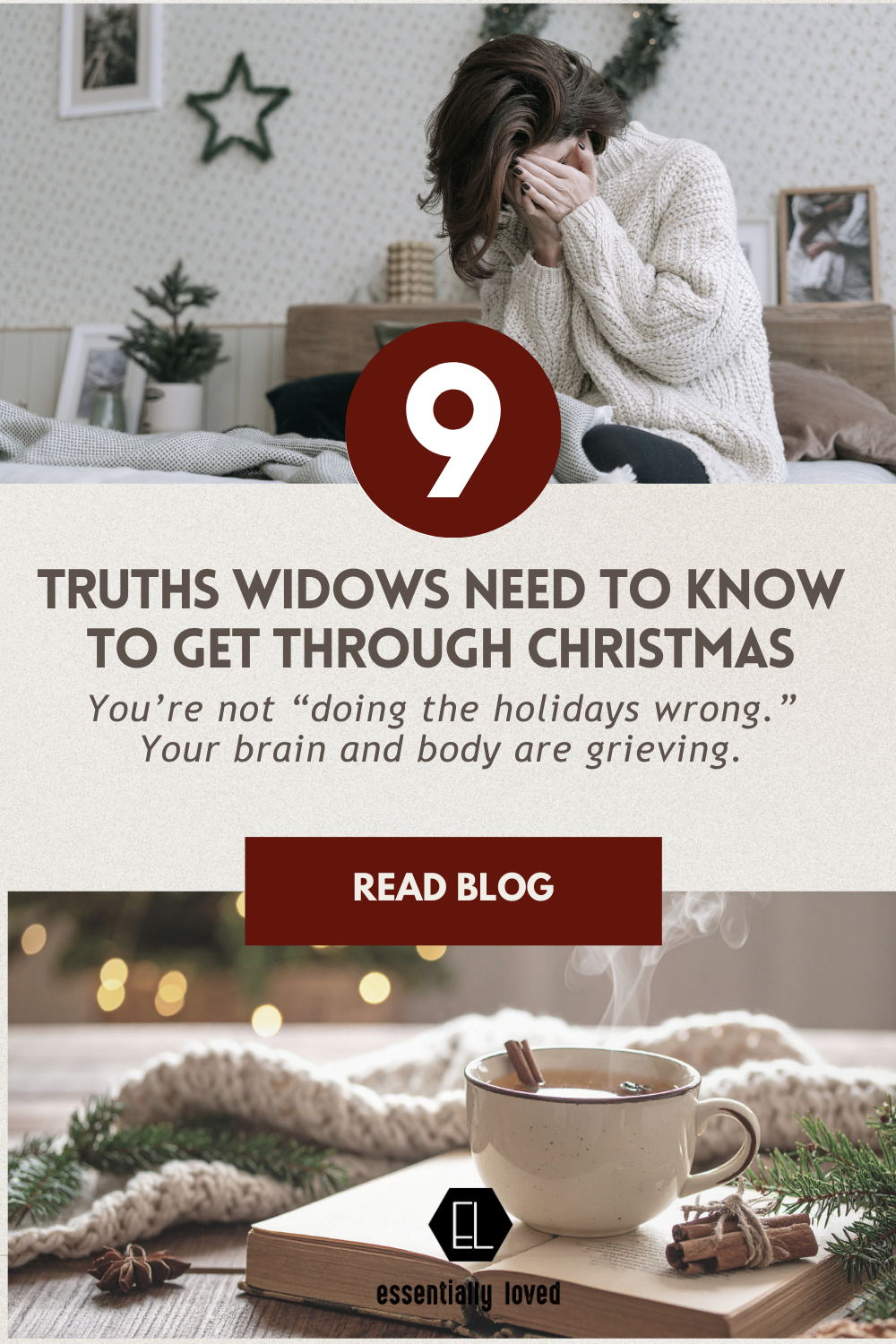
“I’m trying. I really am. But Christmas hits places inside me I can’t explain. My whole body feels the absence — the silence at the table, the vacant chair, the empty side of the bed, the traditions that now feel like a wound. I want people to know I’m not being dramatic. I’m not avoiding joy. I’m just trying to survive something my heart, my mind, and my nervous system never learned how to carry.”
Christmas after loss is heavy.
Not just emotionally — but in your mind, your nervous system, your routines, and your body.
If this is your first Christmas without your person… or your tenth… the holidays have a way of pressing into the bruise. The world moves into celebration; widows often move into survival mode.
This isn’t weakness.
It’s grief.
It’s love.
It’s biology.
It’s the story you’re carrying.
And there are real truths that can help you get through this season with tenderness, capacity, and compassion for your whole self.
Before we get to those truths, here’s the part widows almost never say — but deeply wish others understood.
What Widows Wish Everyone Understood at Christmas — But Rarely Say Out Loud
“I won’t tell you this because I don’t want to ruin your holidays… but I am barely holding myself together.”
“The decorations, the music, the gatherings — they all carry landmines. I never know which one will break me open.”
“I wish I could explain how exhausting it is to look ‘fine’ when inside, I’m either numb or on the edge.”
“I don’t want pity. I don’t need you to fix anything. I just want to be seen without being pushed.”
“If I’m quieter, it’s not because I don’t care. It’s because my nervous system is overloaded.”
“I’m terrified of being ‘too much’ — too emotional, too fragile, too complicated. So I stay silent.”
“It takes courage to show up to anything this month.”
“I want to be invited, even if I can’t say yes. And I want my no, or avoidance to be okay.”
“I still talk to him in my head. I still imagine what he would say. December brings all of that closer.”
“I’m not choosing sadness over joy — I’m choosing honesty over avoiding”
“Your love helps… but nothing fills the space where he should be.”
“Most days, I’m surviving something invisible — but nearly unbearable. It touches everything.”
“I just need someone who lets me be real. Someone who doesn’t rush me. Someone who understands that this isn’t just a season… it’s a whole-body ache I’m learning to live with.”
These are the truths widows live in — silently, bravely — during the holidays.
And here are the truths you need to know to get through them.
9 Truths Widows Need to Know to Get Through Christmas
1. You’re not “doing the holidays wrong.” Your brain is grieving.
Holiday grief isn’t just emotional — it’s neurological.
Widowhood rewires your threat system, your memory pathways, and your emotional regulation. The sights, smells, and sounds of Christmas can activate the deepest parts of loss.
There is nothing wrong with you.
Your brain is trying to protect you.
2. Overwhelm is your body asking for safety.
That tight chest, the sudden exhaustion, the dizziness in crowded rooms…
This is somatic grief.
Your nervous system is overloaded, not broken.
Small grounding moments help:
slower, extended exhale
step outside
hand on your heart
unclench your jaw
Your body needs presence, not pressure.
3. You’re allowed to make Christmas smaller this year.
Widowhood changes capacity.
You can choose:
simple traditions
quiet mornings
new plans
rest over pressure
“not this year”
Your worth is not measured by how well you perform holiday joy.
4. Loneliness during the holidays is not failure.
Holiday loneliness for widows is not about being alone.
It’s about missing the one person who was your witness, your safe place, your home.
Feeling that ache is not weakness — it’s love with nowhere to land.
5. December uses more emotional energy than any other month.
Widows carry:
increased cortisol
impaired sleep
grief-triggered memories
decreased capacity for decision-making
social burnout
Lower your expectations.
Give yourself margin.
Rest is not avoidance — it’s survival.
6. You need a circle of support — even if it feels vulnerable.
Widows hesitate to ask for help.
But connection literally reduces grief’s load on your nervous system.
Ask for:
someone to sit with you
someone to check in
someone to pray
someone to help with tasks
You’re not meant to carry December alone.
7. Your body remembers anniversaries before your mind does.
If your spouse died in winter, or if the holidays were complicated, your body holds that timeline.
That heaviness you feel early in December?
It’s memory stored in your nervous system.
8. Honoring your person is allowed — and healing.
Pick one meaningful thing:
light a candle, make their favorite food, write their name, tell their story.
This isn’t about moving on.
It’s about continuing love in a new form.
9. You do not have to navigate holiday grief alone.
Most widows feel invisible in December.
That’s why I created the Widows Support Letter — a free, gentle, grief-informed newsletter offering:
nervous system tools
somatic practices
spiritual grounding
circle of support helps
grief education
compassionate guidance
reminders you’re not walking this alone
It’s support that meets you in the ache — not above it.
If you're facing the holidays without your person, this is your safe place to land.
You don’t need to be strong.
You don’t need to perform.
You don’t need to pretend you’re okay.
You just need to be held — even for a moment — in a world that doesn’t understand how deep this goes.
👉 Sign up for the free Widows Support Letter below:
Real support. Real stories. Real presence. Especially when the holidays are too much.
Christmas is one of the hardest seasons for widows because grief affects the whole body—mind, nervous system, routines, somatic stress patterns, and emotional capacity. Widows often experience holiday triggers, overwhelm, loneliness, sensory overload, and deep nervous system fatigue. This post offers practical support for widows facing Christmas after loss, including somatic grounding tools, emotional regulation strategies, spiritual support, grief education, and ways to create a circle of support. It explains why holiday grief feels heavier, why the body reacts, and what widows truly wish others understood. This article is written for widows looking for real, compassionate guidance and includes an invitation to join a free Widows Support Letter for ongoing grief support. Keywords: widow holiday grief, Christmas without my husband, surviving Christmas as a widow, grief and nervous system, somatic grief support, holiday grief triggers.

Why It’s Hard to Be Friends with a Widow (and How to Stay Anyway)
Grief doesn’t just change us — it changes our friendships too. One day you’re sharing life with people who knew you “before,” and the next, you’re learning how to stay connected through loss. Here’s why it’s hard to be friends with a widow — and what love looks like when you stay.

When my husband died, I expected grief to change me — I didn’t, however, expect it to change the bulk of my friendships too.
Grief reshaped relationships in ways no one prepared me for. In fact, nobody was talking about it. One day I was sharing everyday life with friends; the next, I was standing awkwardly unsure of how to connect at all.
One day we were swapping stories about dinner plans, the kids, and weekend trips. The next, I was sitting across from familiar faces, feeling like I no longer fit inside the same world. I laughed at the right moments, nodded along, but inside something ached. I was the same — and I was definitely not. I felt as if I was betraying myself by pretending.
For me, the world grew quieter, out of sync, and unknown. For my friends, it grew awkward. Both sides ached for connection, but neither knew how to bridge the gap.
The Rift You Don’t See Coming
No one warned me that loss wouldn’t just take my person — it would rearrange absolutely everything and leave me wondering where I belonged now. Where would I not feel alone?
Our worlds no longer matched.
My world had split in two. Theirs hadn’t. It wasn’t their fault, but it left me suspended between who I had been and who I was becoming. I had no idea what it would take to find my way back — or to wherever I was going. And I certainly had no idea who would stay long enough to walk with me while I tried. I knew my process of finding out was going to be messy.
Triggers hid in the ordinary.
Dinner invites, anniversary posts, a casual mention of “we” — everything that once felt normal began to set off alarms inside of me. Grief didn’t announce it was entering; it simply stormed in, loud and uninvited, right in the middle of simple moments and everyday life.
My brain didn’t work the same.
I retold stories, processes, experiences. I forgot what I had said and to whom I’d already said it. Sometimes I held back because I didn’t want to be “too much,” and other times everything just poured out wildly. Either way, I felt exposed, raw and vulnerable. The inside of me was a garbled mess and any words that came out would be sure to reveal that truth.
Silence filled the gap.
Some friends stopped calling or messaging — I don’t believe it had to do with them being uncaring but much more because they didn’t know how to. The fear of saying the wrong thing kept them quiet, yet the silence hurt more than awkward words would have. Because awkward was my new grieving norm anyway.
My capacity changed without warning.
Some days I wanted company. Other days I couldn’t breathe around people. It wasn’t rejection — it was survival. It was my way of trying to process the uneven weight that grief so abrasively dumps on you.
How to Stay Anyway
If you love a widow, it will feel uncomfortable.
You’ll second-guess your words. You’ll worry about saying too much or doing too little.
But staying matters more than getting it right.
Here’s what I’ve learned from both sides of this fragile space:
1. Show up, even when it’s awkward.
Don’t wait for the perfect words or timing — they don’t exist. Presence is the healing language of grief. Send the text. Sit in the silence. Drop off the coffee even if she doesn’t open the door.
2. Say what’s real.
“I don’t know what to say, but I’m here.”
That kind of honesty builds trust faster than any forced encouragement ever could.
3. Let the friendship change.
It won’t look like it used to — and that’s okay. Grief isn’t going anywhere.
This version will be quieter, slower, more intentional. That’s how love rebuilds itself after loss.
4. Offer small, steady gestures.
Grief drains decision-making and emotional energy. It makes the body tired. A consistent rhythm of small care says, “You’re still seen.” And consistency shows you plan on sticking around.
5. Learn the language of grief.
Listen more than you speak. Ask what helps, what feels heavy, what she misses most.
Let her story be the teacher.
Posture. Presence. Patience.
Over time, I’ve learned these three are what every grieving heart — and every lasting friendship — needs.
Posture: Come as a learner. Listen before you speak. Ask thoughtful questions. Let empathy lead. Hold fewer opinions, give less advice, and make more room for her story.
Presence: Be near. Stay steady when she withdraws, cries, or changes the subject. Your quiet consistency will mean more than you realize.
Patience: Grief takes time to find it’s way, and it’s not linear. Let her move at her own pace. There’s no “before” to return to — only a new kind of life to walk together.
These three — posture, presence, patience — rebuild safety in a world that feels unsafe. They whisper, You’re not too much. I’m not going anywhere.
For the Ones Who Want to Stay
If you’re walking through loss — or walking beside someone who is — I created something for you.
It isn’t a checklist or a script. It’s a way to stay close when things feel uneasy.
Staying Close: What to Say + How to Show Up
A free, practical resource that gives language to the widow and tools to her circle of support —helping both sides find their way to stay connected.
Because the truth is, friendship after loss isn’t ever about saying the right thing.
It’s about standing close enough to feel and engage with what really matters.
Enter your email below to have this helpful information sent to your inbox.


What Not to Say to a Widow (and What to Say Instead)

The worst thing you can say to a widow is a phrase that minimizes her pain, compares her grief, or tries to fix what can’t be fixed. The best thing you can do is offer presence, honesty, and compassion.
When I was newly widowed, I heard words that stung more than silence. People meant well, but their attempts left me feeling more abandoned. This guide is for anyone who wants to love widows well — to bring comfort instead of clichés.
What Not to Say to a Widow
Here are some common phrases widows hear that wound instead of help:
“At least he’s in a better place.”
“Everything happens for a reason.”
“You’ll find someone else.”
“God won’t give you more than you can handle.”
“I know exactly how you feel.”
“You should be moving on by now.”
Why These Words Hurt
They minimize the depth of loss.
They add guilt or shame when grief doesn’t fit a timeline.
They shift focus to fixing instead of being present.
They ignore the uniqueness of every widow’s story.
Grief is not a problem to solve — it’s a story to honor.
What to Say Instead
Here are phrases that bring comfort without pressure:
“I’m so sorry. I can’t imagine the weight you’re carrying.”
“Your love story mattered — and still matters.”
“I don’t have words, but I’m here with you.”
“Can I sit with you?”
“What feels hardest today?”
“Would you like to share a memory?”
Presence-filled words go further than advice ever could.
Gentle Practices for Speaking to a Widow
Pause before you speak. Ask: Will this bring comfort or create distance?
Offer more presence than words. Silence can be holy.
Listen without fixing. A widow’s story matters more than your answer.
Remember important dates. A note or call on anniversaries means everything.
If you’re here because you want to love a widow well, thank you. Your presence matters more. When you choose compassion over clichés, you remind her she’s not abandoned in the hardest season of her life.
Common Questions
“Q: What is the worst thing to say to a widow?
A: Phrases like “At least he’s in a better place” or “You’ll move on soon” often feel minimizing or dismissive.
Q: What words bring comfort to a widow?
A: Honest, compassionate words like “I’m so sorry” or “I’m here with you”.
Q: How can I support a widow without saying the wrong thing?
A: Focus on presence, avoid clichés, and acknowledge their loss directly.
”