

Widow Life: The Distance Found in the Holiday Mist of Cheer.
For the widow who feels flat, forgotten, or unsure where she belongs this Christmas. A tender, grief-informed reflection on why the holidays feel so heavy—and five gentle ways to move through the season with honesty and care.

For the widow who feels flat, forgotten, or unsure if she still belongs.
If you’re reading this, I want you to know something from the start—you’re not ALONE.
There is a distance that can settle in this time of year. You can feel it before you can give it words—somewhere between the first Christmas commercial and the neighbor hanging lights. The whole world shifts into a season of wonder and expectation, and somehow, it creates a widening gap between you and everyone else.
The holidays permeate everything with “magic” and “joy.”
And grief—your grief—seems to move in the opposite direction. Holiday grief hits in ways you can’t prepare for. Christmas grief has its own weight, its own sting, its own silence.
It leaves you feeling isolated. Detached. And if you’re anything like me… sometimes flat.
Not bubbling over with emotion. Not tender and sentimental. Just… less. Less feeling, not more. Less capacity, not more. Less sparkle, less warmth, less of whatever you think you “should” be bringing to this season.
In a world shouting MORE—more family, more events, more decorating, more expectations, more giving, more love on display—you become painfully aware that you have MUCH less to offer. And it makes you start to wonder if you’re even wanted as you currently are.
And if any of this is describing you, breathe. You are not the only widow feeling this way during the holidays. This season awakens a specific kind of ache that deserves to be named, understood, and honored—not hidden.
Because here’s the truth many widows silently carry: for the first time, you wonder if you even belong in your own family anymore. Nothing fits the way it used to. Nothing feels familiar. Part of you is missing, and the part of you that balanced the whole room isn’t there anymore.
Grief has a way of making you feel like you’ve slipped outside the frame of your own life. You watch everyone else move forward while you’re learning how to live with a permanent tear in the fabric of your world. And I know how lonely that place can feel.
So let me say some of the things you may not have words for yet—things widows often feel but rarely speak.
Five Real Thoughts Widows Carry About Not Fitting Anymore

Being a widow brings a lot of thoughts and feelings with it. Navigating the truth and the holidays is possible.
“I feel like the heavy one now.”
Like your presence shifts the room and everyone can feel the ache you try so hard to tuck away.“I worry I suck the joy out of everything.”
You don’t want to. You don’t mean to. But you see the energy change and you blame yourself.“I’m not the same without him… and I don’t know who I am now.”
He was your balance, your grounding, your mirror. Without him, everything feels off-center.“I don’t feel like I fit in my own family anymore.”
Not because they’ve rejected you—but because the dynamic changed when half of you went missing.“I feel too much and not enough at the exact same time.”
Too emotional. Too quiet. Too exhausted. Not joyful enough. Not okay enough. Just… wrong somehow.
If any of that sounds like you, friend… I see you. Truly.
And here is what I need you to hear with your whole heart: none of these thoughts make you weak. None of these feelings make you a burden. They make you human. They make you real. They make you a woman who loved deeply and lost profoundly.
But hear me: that tear in your life doesn’t disqualify you from love.
It doesn’t exile you from your future story.
It doesn’t erase your place at the table.
You’re still here.
And your presence still carries weight—sacred weight the world doesn’t always understand.
Because the way you hold love and loss at the same time?
That is holy ground.
You may feel on the outside looking in, unsure where you fit or how to step into spaces you once entered so naturally. But you are not lost. You are not forgotten. You are not too broken to belong.
You don’t have to perform your way back into the room.
You don’t have to decorate the ache.
You don’t have to twist yourself into something lighter or easier.
Honesty is enough.
Your presence—even tired, quiet, or undone—is enough.
You belong. You are still breathing, still loving, still showing up inside a life you never asked for. That is not weakness. That is sacred strength.
And even if this season feels fractured and unfamiliar, there is still room for you—your truth, your sorrow, your tenderness, your whole story—right here, right now.
Just as you are. Always.
Five Ideas for Navigating the Holidays When You’re Grieving
If you’re looking for ways to move through the next few weeks with honesty, meaning, and supportive connection, here are five quiet and doable ideas. They don’t require you to pretend or perform. They don’t require energy you don’t have. They’re simply small invitations toward real and raw comfort and safety.

Choose one friend from your Circle of Support and ask for a moment for real talk.
Maybe just one true sentence: “This is how I’m doing / feeling today.” Ask if they’d sit with you for a moment this week. No fixing. No pressure. Just presence. Sometimes being witnessed is the deepest relief.Create a small, meaningful ritual at home—just for you.
Light a candle. Say his name. Whisper a memory. Invite Jesus into the quiet. Even two minutes of time like this can soften the deep ache enough to release some grief tension and keep you going.Give yourself an “opt-in” holiday moment.
Skip the big gatherings if you need to. Choose something small—a drive to see lights, a warm drink with someone safe, a slow walk. Give yourself permission to leave early or change your mind if your heart shifts.Release your mental load onto paper.
Your brain is carrying silent weight. Write down every worry, fear, and trigger. This helps both sides of your brain to work together and process more fully. Let it become your prayer: “Jesus, be here with me.” - maybe you want to hold it with care in your journal or maybe you want to toss it in the fire and release it.Create meaning, not performance.
You don’t need a whole tree or a whole house decorated. Choose one grounding thing: a single ornament that represents something meaningful, a Scripture, a song, a cup of hot chocolate. Meaning does not require intensity. Sometimes sitting in softness is the bravest choice you can make.
Know this, I am praying for you. Wherever you are, whatever you are feeling: hope-filled, weary, nervous, numb… begin by recognizing it. Allow it to be recognized and respected. Grief is hard. Carrying love and loss is hard. Take small steps of bravery to allow your natural process. I know God is with you in this chapter and the ones yet to come. He is writing something beautiful now, and in the days ahead.
Sending you so much love,
Kimber

If you’re navigating grief during the holidays, especially as a widow or someone who has lost a spouse, you’re not alone. Many women experience a deep sense of loneliness, disorientation, and not belonging during Christmas and the winter season. This post offers honest support for holiday grief, Christmas sadness, widowhood, and the quiet ache that shows up when family gatherings and traditions look different after loss. If you’re looking for help with feeling out of place, grieving at Christmas, missing your person, or finding gentle ways to care for yourself during the holidays, you’ll find guidance, grounding practices, and compassionate encouragement here. These reflections are written for widows, grievers, and anyone carrying loss into December—offering language, validation, and hope for the season you’re in.
Where Love Still Lives | A Modern Lament of Loss + Remembering
In this modern lament, I share my honest journey through loss and love — how grief reshaped me, and how love still lives within all that remains. You’re invited to write your own modern lament and discover the raw beauty of loved lived out after you lost someone.
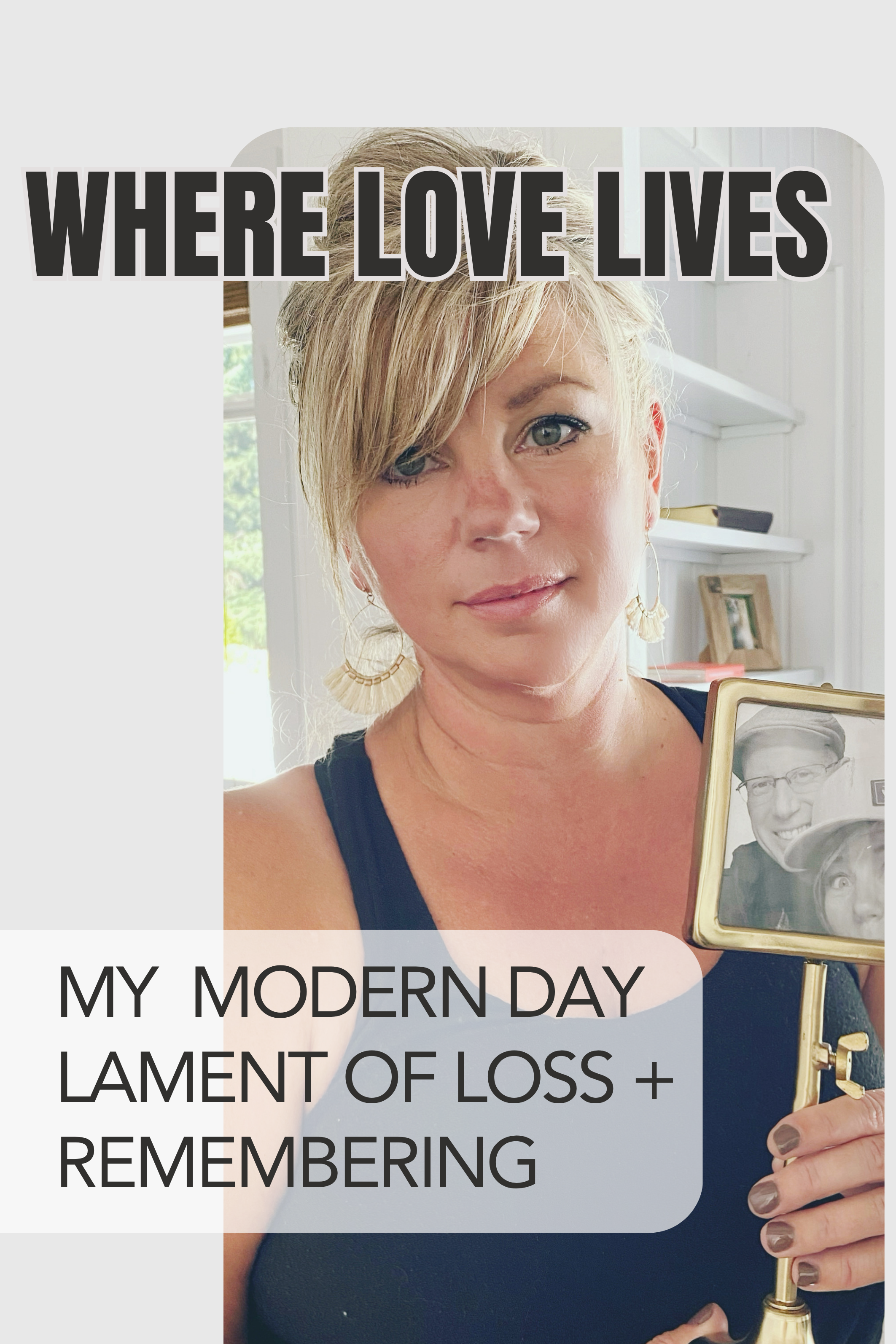
Where Love Still Lives
A Modern Lament
Before You Read
I want you to lean in and listen to this…
Love does not die when we lose our person. And in ways our person doesn’t either.
I know that may sound a bit strange, but let’s think about it for a minute. We do indeed stop physically living beside the person we love, but in our mind and hearts we keep living with them — through memory, story, laughter, faith, and the everyday ways their love still lingers in who we are and the memories that have shaped us.
When I first started writing again, I wasn’t trying to create something beautiful. I was trying to release, process, leak out my emotions…. survive basically.
There were feelings that words couldn’t hold and silence that felt unbearable. Writing became a way to speak when my heart didn’t have language yet — to honor what was, to name what still was, and to remember that love hadn’t gone anywhere.
And even now, as I write this, six years later… I am still finding a beautiful release in the writing of raw words — today it was the unfolding of my modern lament.
It’s honest. It’s messy. It’s love and loss braided together.
And I share it with you because maybe you’ve felt that too — the strange ache of loving someone who isn’t here, yet still is. Here we go:
Where Love Still Lives
My modern lament of loss + remembering.
One minute we were laughing, planning out our days. And then suddenly we were sitting behind a curtain — so many questions, so many tests.
It was the beginning of pain I’d never known before.
Pain that reached down deep and rearranged everything.
Fourteen months. They flew by and dragged on all at once. Hope. Fear. Love. Torment. All tangled up together, twisting through the same days.
The deepest kind of love I’ve ever felt —
the kind that digs into your soul,
planting memories you don’t want to forget,
even as you’re watching the leaves of your family tree start to wither.
I wanted to hold on tight — to every moment, every breath, every look. Because I knew the end of us was coming. And the knowing stole my air.
There were days I had to run outside,
just to see the world going on,
but at the same time everything in me wanted it to stop.
Because I knew the faster it moved the sooner we would end.
I would try to imagine myself walking without you —
living on without you
but I couldn’t. The thought of it made my body shut down.
Sometimes I’d start gasping for air, other times dry heaving — that’s the ugly, beautiful truth of love that hurts. It takes your breath even when you’re trying to hold it.
And yet, here I am today. Still breathing. Still holding you — maybe tighter than ever. You’re here, just differently now. Not beside me, but within me. You live in my heart and in my mind, woven into the threads of my being.
People say time heals,
but I don’t believe that.
Time doesn’t erase love —
Neither does death —
it just changes its form.
The ache stays,
but so does the gift of you.
The way you loved.
The way you gave.
The way you taught me what it means to stay.
I still see you.
I see you in the way our children love others,
serve others,
show kindness and generosity.
You taught them that.
I still hear you —
in their laughter,
their morals,
their love for Jesus.
I remember how you looked right at them —
steady eyes, a firm resolve —
and you asked,
“Do actions speak louder than words?”
They answered,
and you smiled.
You said,
“That’s right… love well.”
And that’s what we’re here still trying to do. To love well. To live like you did — with faith, with courage, with kindness.
Your life mattered.
And your love carries on.
We hold it dear.
In the same space as the ache of missing you.
Love still lives here.
Right here.
Inside all that remains.
Why This Matters
I think we forget sometimes that grief is love — still living, still reaching, still remembering.
Writing a lament like this doesn’t make the pain go away, but it gives it somewhere to rest — to be valued, and recognized.
It allows us to see that even in the cracks of heartbreak, love keeps growing.
If you’ve lost someone you love, try writing your own Modern Lament.
It doesn’t have to sound poetic or polished — it just needs to sound like you.
It’s a sacred way to tell your story of loss, to remember what you are still carrying, and to let God meet you in the ache.

You can start with a few simple questions:
What did I go through?
Where do I still feel their presence in my life today?
What did they give me that I still carry?
What do I want to remember about the love we shared?
Write it for you.
Not to move on, but to move with.
Because love doesn’t end when life does — it carries on, with us.
And sometimes, naming that love is how we keep breathing.
Write Your Own Modern Lament
A Guided Reflection for the Ones Still Learning to Live with the Love That Remains
If something in you stirred while reading this — that ache, that knowing — maybe it’s time to put words to your own story.
To honor your journey and let your heart speak what it’s been carrying.
This is how we begin to live with love in a new way — not gone, but woven in.
I’ve created a gentle guide to help you start.
Inside, you’ll find prompts and simple steps to help you hold what still hurts while remembering what still matters.
→ Get the free guide: Write Your Own Modern Lament
(It will arrive in your inbox with other valuable information about walking with grief.)
Because love still lives here — even in the midst of the ache.
And sometimes the most sacred thing we can do
is let it speak.