7 Goals That Actually Matter for Widows in 2026
Losing your husband doesn’t just break your heart—it reshapes your body, your faith, and your capacity for life. These seven grief-informed goals offer widows a different way forward in 2026—one rooted in safety, connection, and honest care beyond survival.

Losing your husband is disorienting.
There’s no easing into it. Grief doesn’t arrive gently—it takes you out. It knocks you flat on your face.
You try to get up, but the energy it takes just to stand leaves your legs shaky. The thought of walking forward—of moving into a life shaped by this kind of loss—feels beyond exhausting. Overwhelming in ways you didn’t know were possible.
Over time, you find a rhythm.
You learn how to get through the days. How to function. How to survive.
And for a while, survival feels like enough.
But somewhere along the way, a quieter question starts to surface—one you might not even say out loud:
Is survival really all there is now?
What if God has more for you than just surviving the death of your husband?
What if He honestly has more than just getting you through the day?
What about a life that still holds meaning?
What about purpose that doesn’t feel forced or fake?
What about moments that actually feel life-giving—the kind that settle your body, soften your thoughts, and remind you there is still goodness to be found, even here?
Because losing a spouse doesn’t just break your heart.
It changes how your brain works.
It changes how your body carries stress, fatigue, and emotion.
And it can quietly shift how you experience God, leaving Him feeling distant, muted, or harder to reach than He used to be.
Widowhood takes so much.
And yet… it also asks something new of us.
Not to move on.
Not to rush healing.
But to find a different rhythm—one that goes beyond survival and slowly opens space for life again.
That’s what these seven goals are about.
Not resolutions.
Not pressure.
Just what actually matters for widows stepping into 2026.

7 goals to help a widow move out of survival mode in 2026
1. create a heart space for your grief
Grief needs to be felt and processed to move.
So many widows carry the load internally—processing in their heads, over and over again. Ruminating. Over time, that kind of carrying becomes exhausting.
Making a heart space is about permission.
Permission to pause.
Permission to feel.
Permission to be honest.
This might look like creating a physical Grief Nook—a cozy chair, a journal, a wrap, a few meaningful objects. And time, time to be intentional. Time set aside where grief is allowed to exist without interruption.
Grief moves differently, more freely, when it knows it has a safe place to land and process.
And so do you. Having a physical space designed specifically to hold you well as you try new ways of processing the loss you carry with you — helps you to feel safe, seen, held and free to release.
2. Help your body feel safe
Grief doesn’t only live in the heart—it lives in the body.
After loss, the nervous system often stays on high alert. Sleep changes. Startle responses increase. Rest feels shallow or unreachable.
You can’t think your way out of that. Ruminating won’t resolve this.
Helping your body feel safe again might look like gentle grounding techniques, breath prayers, sensory awareness, or stillness. Small, repeated practices matter more than big efforts.
Science tells us that consistency helps the nervous system relearn safety. But even without knowing the science, most widows feel it when their body finds ways to exhale.
This isn’t about fixing the loss… because we can’t.
It’s about caring for yourself, and reminding yourself you are still safe and held in the midst of the ache.
3. Finding new ways to Sit with Jesus in your grief
Grief changes faith.
Prayer time shifts.
Scripture lands differently.
God can feel quieter—distant.
Many widows carry this unspoken thought:
”I don’t know how to be with God like I used to. I’m just not feeling it.”
God hasn’t changed but our ability to be present, connect, and feel safe in this world has..
This leads us to an invitation.
Sitting with Jesus in your grief and building authentic connection can look and feel very different after an extreme loss. Sometimes it looks like silence. Sometimes brutal honesty. Sometimes it’s a creative process. Often it is by engaging the imagination differently.
Jesus isn’t waiting for you to be “better.”
He’s already here. Right in the midst. He understands + loves you in the most tender way.
He sees you.
4. Practice gratitude without pretending
Gratitude after loss can feel very complicated.
It’s often mistaken for denial or forced positivity—and that’s not what this is about. At all.
This isn’t about slapping a grateful face on a broken heart or convincing yourself things are okay when they’re not.
And yet… there’s something important here.
Consistent gratitude practices are known to support the brain and nervous system, especially after trauma. They don’t erase pain—but they do help the mind notice moments of safety and goodness alongside grief, not instead of it.
That matters.
Because grief keeps the brain on high alert. And gratitude, practiced gently and honestly, can help soften anxiety and bring the nervous system out of constant bracing.
One simple rhythm many widows find supportive looks like this:
noticing small, everyday moments that don’t hurt
returning to a few big anchors that have carried you over time
Noticing doesn’t mean celebrating.
It just means allowing your brain to register something neutral or good without arguing with it.
Over time, this kind of practice helps different parts of the brain work together more smoothly. It creates small shifts—less looping, a little more breath, a little more space.
This isn’t about pretending life is okay.
It’s about helping your brain remember that goodness still exists in the middle of grief.
And sometimes, that’s enough for today.
GOAL 4 - Try listing 12 small gratefuls from the last 24 hours — little things you are thankful fo. And list 3 BIG gratefuls over the span of your life. Make a daily practice of this.
5. Move in ways that help grief move
Grief lives in the body.
Unprocessed emotion often shows up as tension, fatigue, pain, illness or restlessness. Thoughts loop. Emotions and experiences get stuck.
And surprisingly, movement doesn’t have to be an intense workout to be effective.
Walking. Stretching. Dancing. A gentle rhythm. Breathing while moving.
Somatic practices help emotions complete their cycle instead of lodging inside the body. Over time, movement can soften anxiety, bring clarity, and help your system release what it’s been holding.
In 2026, let movement be about listening, relaxing + releasing—not pushing.
6. Connection of the heart
Grief isolates in quiet ways.
Not always because people leave—but because it becomes harder to know how to share what’s real. You don’t want to overwhelm anyone. You don’t want to manage their reactions. Sometimes you don’t even know where to start.
Connection doesn’t have to mean a crowd.
It might be one trusted friend.
It might be a small grief group.
It might be intentional conversation where honesty is welcome and fixing or resolving is not the goal.
Grief moves differently when it’s witnessed. When it is held with care and kindness.
This is the heart behind The Widow’s Table Challenge—a six-week invitation into intentional, grief-informed conversation for widows and the friends who want to love them well.
No platitudes.
No pressure.
Just space to speak and be heard.
If you want more information on this sign up for the newsletter below. It will be coming out in January.
7. Letting your love go somewhere again
One of the quieter, less recognized, losses in widowhood is this:
your love suddenly has nowhere to go.
Your encouragement.
Your care.
Your tenderness.
Many widows unconsciously tuck this away, believing it’s safer not to offer too much of themselves. Or believing they don’t have the energy or will to offer it.
But we were created to love others. Love that has nowhere to go doesn’t disappear—it turns inward and grows heavy.
Letting your love go somewhere again doesn’t mean getting into a romantic relationship, or over-giving, or rescuing. It simply means allowing the gift of you, or something you have to offer, to be shared in a way that feels safe and life-giving.
Love is still a part of who you are. What you still carry and still have to offer.
And someone, somewhere, in this broken world needs what God has given you to offer.
Something thoughtful, something small, or big. A kind word, a thoughtful card, a meal…
2026 Goal - make a weekly pattern of giving some love and encouragement from your heart to another.
A word about time - Schedule it, write it down.
Grief has a way of distorting time.
Days blur.
Weeks slip by.
Months pass and you wonder where they went. And change can be hard.
This is where writing things down can be quietly powerful—not to track progress, but to help your brain light up. What fires together, wires together.
Journaling your grief experiences, recording your daily gratefuls, planning your weekly gives, or simply recording small rhythms can help anchor meaning in a season that often feels scattered.
This mattered.
I mattered.
This moment counted.
A gentle invitation
If this resonated, recognize that you’re not behind.
You noticed, you’re paying attention, and you are headed into new areas.
Through my newsletter, I share:
Grief Nook setup ideas
Somatic practices for nervous system care
Journal rhythms that don’t add pressure
Science-informed grief support
Details about The Widow’s Table Challenge
No fixing.
No rushing.
Just thoughtful + kind care for yourself in the wake of deep loss.
You are so welcome here. Just as you are.
And you’re welcome at the table.
Widows, do you need help moving beyond survival mode? Here are 7 steps you can make a priority in 2026.
Widowhood impacts the brain, body, faith, and relationships in profound ways that often go unseen. This grief-informed reflection offers widows practical and compassionate guidance for life after the loss of a husband, including nervous system support, somatic grief practices, spiritual connection with Jesus, honest relationships, and community care. Written for widows seeking meaning beyond survival, this article explores holistic grief support, faith after loss, and relational healing through intentional practices and safe connection. Additional resources, including grief journaling, Grief Nook setup, somatic tools, and the Widow’s Table Challenge, are available through ongoing support shared by the author.
Unfelt Grief | How to Honor Your Sadness + Process Through It

Pain, it’s natural for us to want to avoid it, right? Our built in avoidance techniques shift into gear before we even recognize them. This leads us to a place of trapped emotions. These emotions can wreak havoc in our mind and bodies.
I don’t know what events lead you here. But for me the alarms signals began blaring after I lost my husband. I had been through a lot of loss + hardship prior to. Unfortunately, I thought I was handling the past events fine. As I have been learning new ways to process my sadness and recognize triggers old stuff has emerged as well. My body was keeping the score.
So in this post I want to WELCOME YOU to a simple practice of honoring your sadness. Helping you to see that you don’t need to be afraid of it or press it down. I want you to have freedom from the fear of sadness leaking out or erupting by practicing ways to welcome it. With the practice of holding sadness sessions, by allowing it and moving it through, it will help release a lot of the pressure of the unexpected outbursts. Oh, triggers will still bring some tears but they may not have the same energy behind them and you will know what helps you to move through it. This really helps, truly.
You want to start by creating a safe space and protected time. Someplace you feel comfortable and won’t be easily interrupted. You may want music playing, essential oils diffusing, a candle lit, a cozy blanket, or the fresh air with grass underneath you. Just find space somewhere that you feel safe enough.
The next thing I do is grab some scriptures and read them asking God for his clarity and truth to be present as I begin to feel and process. I invite Him into the space with me. This reminds me that I am NOT ALONE, He is leading.
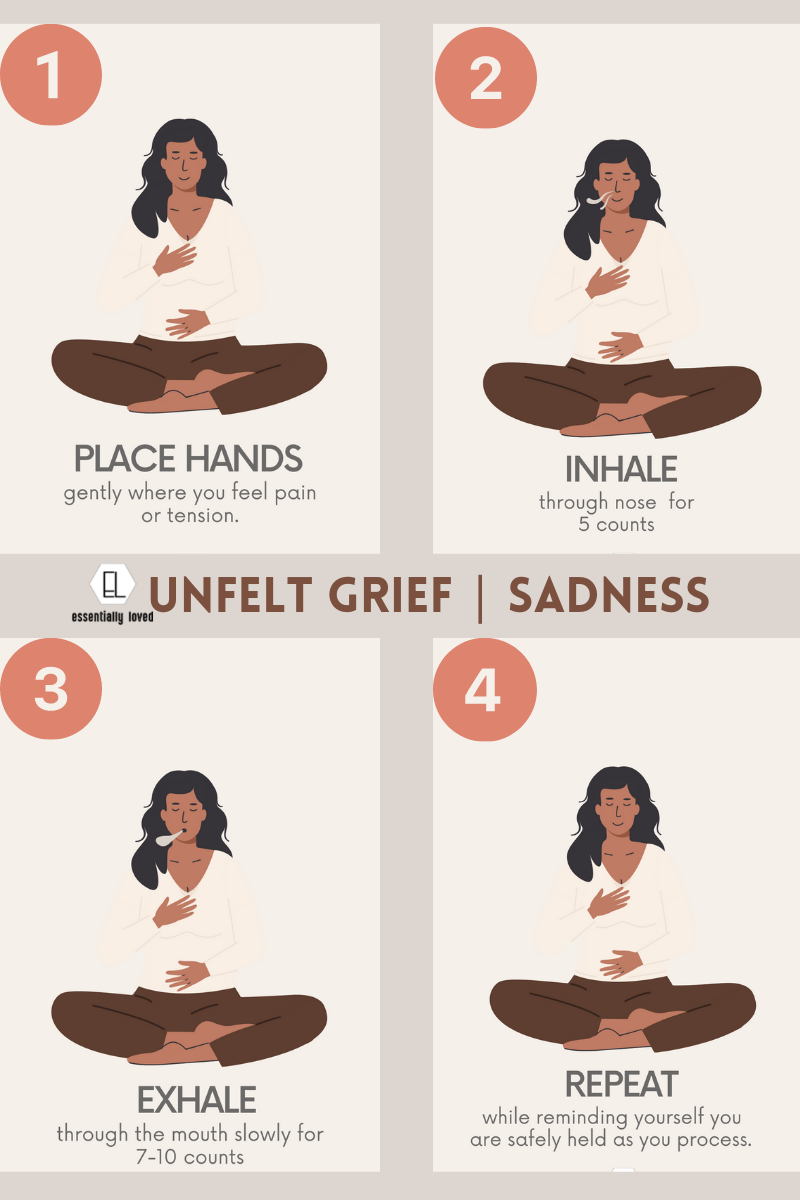
Then I grab an essential oil and put a drop in the palm of my hand and rub my palms together. While my brain is preparing to settle into the memories or situation I am doing my deep breathing. In through my nose for 5 seconds, exhale through my nose for 7-11 seconds. and repeat, and repeat, and repeat. Eventually I drop my hands, my eyes are closed and tears are streaming. (Keep the tissue close by and make sure the oils aren’t on your finger tips for the tear wipes.)
Often during this time Jesus arrives on the scene and shows me something new about it. Not always, but often. When that I like to journal down the notes.
This process seems simple enough, doesn’t it? Just wait until you make a commitment to start practicing this and you will see how powerful it is. God is a creative God and as you begin trying this He will show you new things to try and do in response.
The goal of this isn’t to circle and spin in one thought, it is to learn how to move through them. These hurts are stored in our memory banks but how we respond to them makes a big difference in how we show up in the world. If you feel stuck you may need professional help to learn some new techniques or skills. Don’t be afraid of that either. Seeking help is one of the bravest things you can do and it is such a terrific reminder that you are not in this alone. People care and want to help you!
I am also listing oils specifically helpful for processing sadness. These essential oils can do a multitude of things but today I am sharing a list of them for emotional support with sadness. Breathe is exceptionally good for this particular practice as it opens the airways and clears thinking.

Hope essential oil blend
Rose essential oil
Console essential oil blend
Citrus Bliss essential oil blend
Ylang Ylang essential oil
Siberian fir essential oil
Peppermint essential oil
Eucalyptus essential oil
These are terrific natural options for helping your mind to relax, release, feel and move through.
I’m praying for you and your process. I know God is with you in this, and so am I.