
When Grief Makes Your World Small: The Healing That Happens When You See Someone Else’s Story
Grief makes your world small, tight, and closed in. But something sacred happens when you step into someone else’s story. This raw, honest reflection invites widows into healing through empathy, witness, and the gentle ways God moves through our brokenness.

There’s something I don’t think most people understand about grief — especially the kind that comes after losing your person.
It makes your world small.
Tight.
Closed in.
You don’t do it on purpose.
You’re not trying to shut people out.
It just… happens.
Your body is trying to survive.
Your mind is trying to make sense of a life that seemed to break down overnight.
And your spirit is trying to remember how to breathe in a world that suddenly feels unsafe.
So you fold inward.
You get quiet.
You stay in your head.
You live inside this awful ache because that’s the only place that feels real anymore.
But here’s the thing — and this is the part I wish I could sit across from every single widow and share:
There is something deeply healing that happens when you step outside your own story long enough to see someone else’s.
Not with effort.
Not with “I should.”
Not with pretending your grief isn’t heavy.
But with honesty… and a little courage… and the tiniest willingness to look up.
When I was drowning in my own grief — truly drowning — the only thing that helped me keep moving forward was entering into someone else’s story. Sitting with their pain. Seeing their grief truths. Letting God's love move through me even when I felt like I had nothing left.
And it’s wild, honestly… because it shouldn’t make sense.
How can pouring out love when you feel empty bring healing?
How can holding space for someone else while you’re shattered do anything but drain you?
But it doesn’t drain you.
Not when it’s real.
Not when you’re not forcing anything.
Not when it’s done in response to Jesus.
It actually ignites something.
I’ve felt it happen in real time — that quiet spark in my chest, that soft reminder that my story is not done, that God is somehow using my brokenness to breathe life into someone else.
That’s the Holy Spirit.
That’s love in action.
That’s what happens when grief meets compassion.
And there’s real science behind this, which honestly still amazes me.
When we enter someone else’s story with empathy — especially in shared suffering — the brain releases oxytocin. This is the “bonding” hormone. The “you’re safe with me” hormone. The “you’re not alone” signal our bodies desperately need.
It lowers cortisol — that stress hormone that grief sends skyrocketing.
It softens the nervous system.
It opens the heart and you begin to breathe again.
It reminds you that you still have feelings.
Still have love.
Still have the ability to give something meaningful even when you feel emptied out.
And this part is important:
This isn’t bypassing your own grief.
This isn’t minimizing your pain.
This isn’t trying to pretend you’re okay.
It’s the opposite.
It’s God meeting you in the raw center of your sorrow and saying, “Watch what we can do…”
Because when you step into someone else’s story — even for a moment — you’re not abandoning your own.
You’re letting Jesus shine a bit of His love through the cracks that have felt useless or unworthy.
And scripture backs this.
John tells us that perfect love casts out fear — not your strength, not your resilience, not your best attempts to be okay… love.
God’s love through you.
God’s love toward you.
God’s love weaving stories so no one has to sit in the dark alone.
I used to think I needed to “heal first” before I had anything to offer.
But that was a BIG FAT lie — a straight-up lie from the enemy.
The truth is this:
Love doesn’t stop, get bruised, or pause for you to be healed in order to flow through you.
God doesn’t wait for your story to be tidy and neat before He uses it.
And grief doesn’t disqualify you from being someone who brings light into the world.
In fact… your grief might make you more tender, more aware, more present than you ever were before.
You don’t have to feel whole to offer love.
You just have to be willing.
And even that willingness?
He gives that too.
The Sacred Work of Bearing Witness
One of the most powerful things I’ve learned in grief is this:
You don’t have to fix someone to love them.
You just have to witness them.
Bearing witness is holy ground.
It’s looking at someone else’s pain without trying to tidy it.
It’s listening without offering answers.
It’s saying, with your presence, “I see you. You’re not alone in this moment.”
And something surprising happens when you do this — even while you’re grieving yourself:
You remember that your heart still works.
You remember that God is still moving.
You remember that tenderness still lives inside you, even on the days you feel numb.
Bearing witness isn’t about giving out what you don’t have.
It’s about letting your story sit beside someone else’s story and trusting that God will do the weaving.
Because grief convinces us that we’re useless.
That we’re too broken to show up for anyone else.
That our pain disqualifies us from offering comfort.
But the truth?
Grief has trained your heart to recognize suffering.
You see it differently now.
More clearly.
More honestly.
More compassionately.
Your presence carries weight — not because you’ve healed, but because you understand.
And when two hurting hearts sit side by side, Jesus sits with them.
Not to erase the grief, but to breathe life into the space between.
That’s bearing witness.
And it is both a gift to others and a healing balm for you.
5 Practical Ways to Enter Someone Else’s Story Without Overwhelming Yourself
These are gentle, grief-friendly ways to show up without abandoning your own emotional limits.
These are the steps I lived.
The ones that kept me soft when life seemed determined to harden everything.
Offer Presence, Not Solutions
You don’t need answers.
You don’t need wisdom.
You don’t need to say the right thing.
Just offer a moment of presence.
“I’m here. You don’t have to walk this alone.”
Presence heals what explanations never will.Let Your Listening Be Slow and Unrushed
When someone shares their pain, don’t sprint to the ending.
Sit with them in the middle.
Slow listening says, “Your story matters. You don’t need to be faster for me.”Share Only From Your Scars, Not Your Open Wounds
You don’t have to match their pain with your own.
But a gentle “I understand some of this” offers solidarity instead of comparison.Keep It Small, Simple, and Honest
Showing up doesn’t have to be big.
A voice memo.
A five-minute conversation.
A text that asks for nothing in return.
Small acts carry big presence.Let Jesus Fill the Space You Don’t Have Words For
Whisper, “Jesus, be here.”
He fills what you cannot.
He holds what neither of you can carry alone.
Here’s the beauty widows rarely hear:
Showing up for someone else in small, honest, grief-soft ways doesn’t empty you…
It grounds you.
It connects you.
It reminds you that your life still holds purpose.
That your love is still needed.
That God is still moving through your tired, hurting heart.
You are not useless.
You are not too broken.
You still carry something sacred to give — even now.
Especially now.
If You Want to Step Into Another Story With Me
One of the things that surprised me most in grief was how healing it was to enter into stories far beyond my own — especially the stories of widows in Kenya and Tanzania who carry both unimaginable weight and remarkable strength.
Their lives, their resilience, their faith… it changed something in me.
It opened my world back up when grief had made everything so small and tight.
If you’ve ever felt the nudge to step into someone else’s story — gently, slowly, in a way that brings life to both of you — I want you to know there’s room for you inside the work we do with Pamoja Love.
Through our Widow Project, we come alongside widows who are navigating heartbreak, cultural pressure, spiritual resilience, and the daily struggle to keep their families fed and safe.
And every time we stand with them, something holy happens:
Their story touches ours.
Our story touches theirs.
And God moves in the middle.
It’s not charity.
It’s not “helping the needy.”
It’s story joining — grief with grief, strength with strength, hope with hope.
If your heart is longing for a way to feel connected again…
If you want to witness courage that awakens something inside you…
If you want to know that your story still has something sacred to give…
You’re invited to join us.
Whether it’s praying for a widow by name, helping provide food for her children, supporting leadership training, or simply learning more about her world — you are stepping into a place where love, empathy, and healing move both directions.
And maybe… just maybe…
God will use their story to breathe a little life into yours, the same way He did for me.
If you want to learn more, you can visit: Pamoja Love Nonprofit
www.pamoja.love
and explore the Widow Project.
There is room for you here too.
Your grief.
Your tenderness.
Your story.
All welcome.

Ideas for when grief makes your world feel small.
This post explores grief, widowhood, empathy, nervous system healing, Christian faith, and the emotional and physiological impact of bearing witness to someone else’s story. It includes grief science, widow support, oxytocin and cortisol explanation, faith-based grief encouragement, and practical tools for healing. For widows searching for understanding, Christian grief resources, grief community, nervous system support in grief, or how to navigate sorrow with Jesus, this article provides compassionate guidance, trauma-informed wisdom, and spiritual grounding.
Where Love Still Lives | A Modern Lament of Loss + Remembering
In this modern lament, I share my honest journey through loss and love — how grief reshaped me, and how love still lives within all that remains. You’re invited to write your own modern lament and discover the raw beauty of loved lived out after you lost someone.
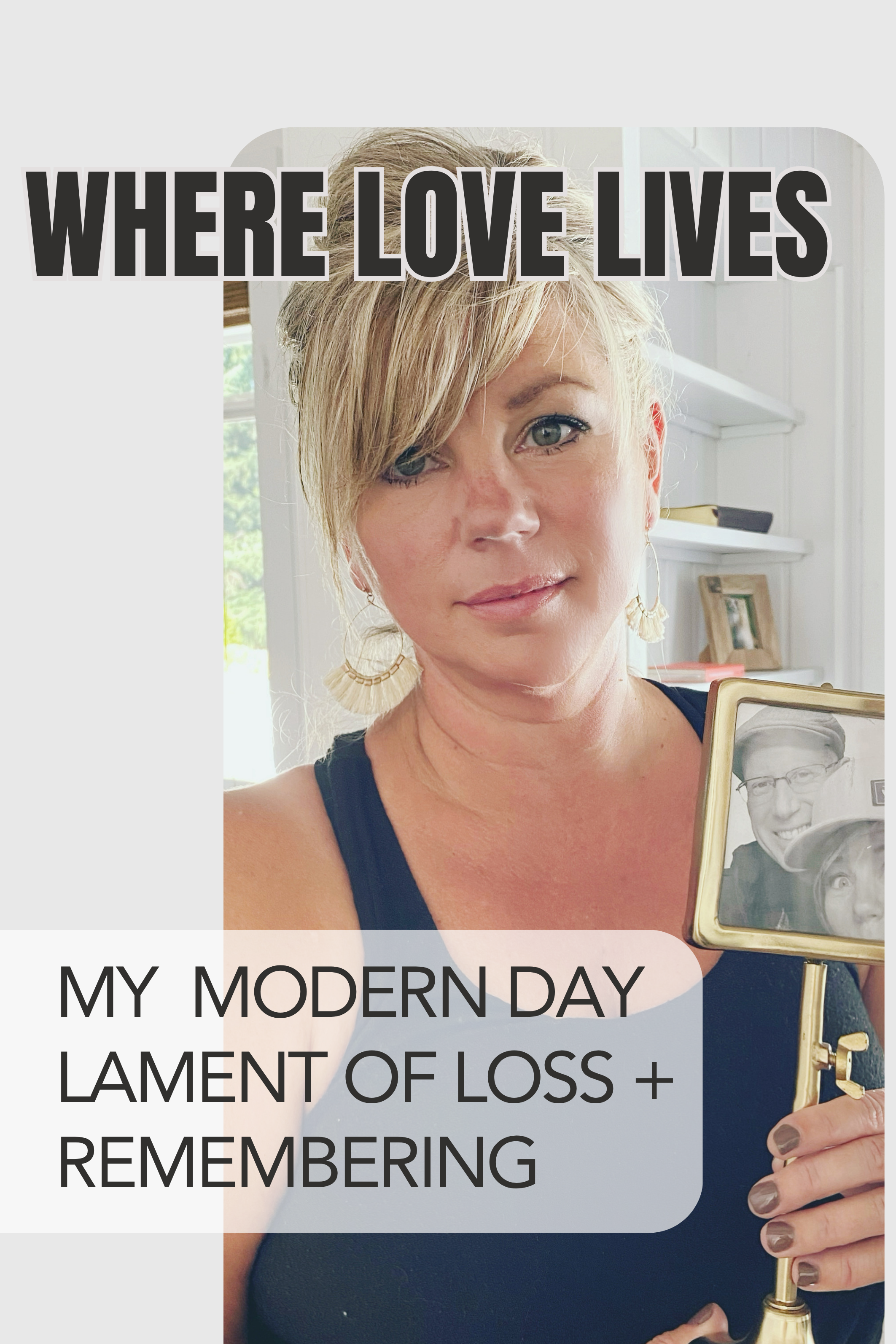
Where Love Still Lives
A Modern Lament
Before You Read
I want you to lean in and listen to this…
Love does not die when we lose our person. And in ways our person doesn’t either.
I know that may sound a bit strange, but let’s think about it for a minute. We do indeed stop physically living beside the person we love, but in our mind and hearts we keep living with them — through memory, story, laughter, faith, and the everyday ways their love still lingers in who we are and the memories that have shaped us.
When I first started writing again, I wasn’t trying to create something beautiful. I was trying to release, process, leak out my emotions…. survive basically.
There were feelings that words couldn’t hold and silence that felt unbearable. Writing became a way to speak when my heart didn’t have language yet — to honor what was, to name what still was, and to remember that love hadn’t gone anywhere.
And even now, as I write this, six years later… I am still finding a beautiful release in the writing of raw words — today it was the unfolding of my modern lament.
It’s honest. It’s messy. It’s love and loss braided together.
And I share it with you because maybe you’ve felt that too — the strange ache of loving someone who isn’t here, yet still is. Here we go:
Where Love Still Lives
My modern lament of loss + remembering.
One minute we were laughing, planning out our days. And then suddenly we were sitting behind a curtain — so many questions, so many tests.
It was the beginning of pain I’d never known before.
Pain that reached down deep and rearranged everything.
Fourteen months. They flew by and dragged on all at once. Hope. Fear. Love. Torment. All tangled up together, twisting through the same days.
The deepest kind of love I’ve ever felt —
the kind that digs into your soul,
planting memories you don’t want to forget,
even as you’re watching the leaves of your family tree start to wither.
I wanted to hold on tight — to every moment, every breath, every look. Because I knew the end of us was coming. And the knowing stole my air.
There were days I had to run outside,
just to see the world going on,
but at the same time everything in me wanted it to stop.
Because I knew the faster it moved the sooner we would end.
I would try to imagine myself walking without you —
living on without you
but I couldn’t. The thought of it made my body shut down.
Sometimes I’d start gasping for air, other times dry heaving — that’s the ugly, beautiful truth of love that hurts. It takes your breath even when you’re trying to hold it.
And yet, here I am today. Still breathing. Still holding you — maybe tighter than ever. You’re here, just differently now. Not beside me, but within me. You live in my heart and in my mind, woven into the threads of my being.
People say time heals,
but I don’t believe that.
Time doesn’t erase love —
Neither does death —
it just changes its form.
The ache stays,
but so does the gift of you.
The way you loved.
The way you gave.
The way you taught me what it means to stay.
I still see you.
I see you in the way our children love others,
serve others,
show kindness and generosity.
You taught them that.
I still hear you —
in their laughter,
their morals,
their love for Jesus.
I remember how you looked right at them —
steady eyes, a firm resolve —
and you asked,
“Do actions speak louder than words?”
They answered,
and you smiled.
You said,
“That’s right… love well.”
And that’s what we’re here still trying to do. To love well. To live like you did — with faith, with courage, with kindness.
Your life mattered.
And your love carries on.
We hold it dear.
In the same space as the ache of missing you.
Love still lives here.
Right here.
Inside all that remains.
Why This Matters
I think we forget sometimes that grief is love — still living, still reaching, still remembering.
Writing a lament like this doesn’t make the pain go away, but it gives it somewhere to rest — to be valued, and recognized.
It allows us to see that even in the cracks of heartbreak, love keeps growing.
If you’ve lost someone you love, try writing your own Modern Lament.
It doesn’t have to sound poetic or polished — it just needs to sound like you.
It’s a sacred way to tell your story of loss, to remember what you are still carrying, and to let God meet you in the ache.

You can start with a few simple questions:
What did I go through?
Where do I still feel their presence in my life today?
What did they give me that I still carry?
What do I want to remember about the love we shared?
Write it for you.
Not to move on, but to move with.
Because love doesn’t end when life does — it carries on, with us.
And sometimes, naming that love is how we keep breathing.
Write Your Own Modern Lament
A Guided Reflection for the Ones Still Learning to Live with the Love That Remains
If something in you stirred while reading this — that ache, that knowing — maybe it’s time to put words to your own story.
To honor your journey and let your heart speak what it’s been carrying.
This is how we begin to live with love in a new way — not gone, but woven in.
I’ve created a gentle guide to help you start.
Inside, you’ll find prompts and simple steps to help you hold what still hurts while remembering what still matters.
→ Get the free guide: Write Your Own Modern Lament
(It will arrive in your inbox with other valuable information about walking with grief.)
Because love still lives here — even in the midst of the ache.
And sometimes the most sacred thing we can do
is let it speak.